


Job strain and changes in the body mass index among working women: A prospective study
Supporting Files

-
May 19 2015
-
Details
-
Alternative Title:Int J Obes (Lond)
-
Personal Author:
-
Description:Objectives
The relationship between job strain and weight gain has been unclear, especially for women. Using data from over 52 000 working women, we compare the association between change in job strain and change in BMI across different levels of baseline BMI.
Subjects/Methods
We used data from participants in the Nurses’ Health Study II (n=52 656, mean age = 38.4), an ongoing prospective cohort study. Using linear regression, we modeled the change in BMI over 4 years as a function of the change in job strain, baseline BMI, and the interaction between the two. Change in job strain was characterized in four categories combining baseline and follow-up levels: consistently low strain [low at both points], decreased strain [high strain at baseline only], increased strain [high strain at follow-up only], and consistently high strain [high at both points]. Age, race/ethnicity, pregnancy history, job types, and health behaviors at baseline were controlled for in the model.
Results
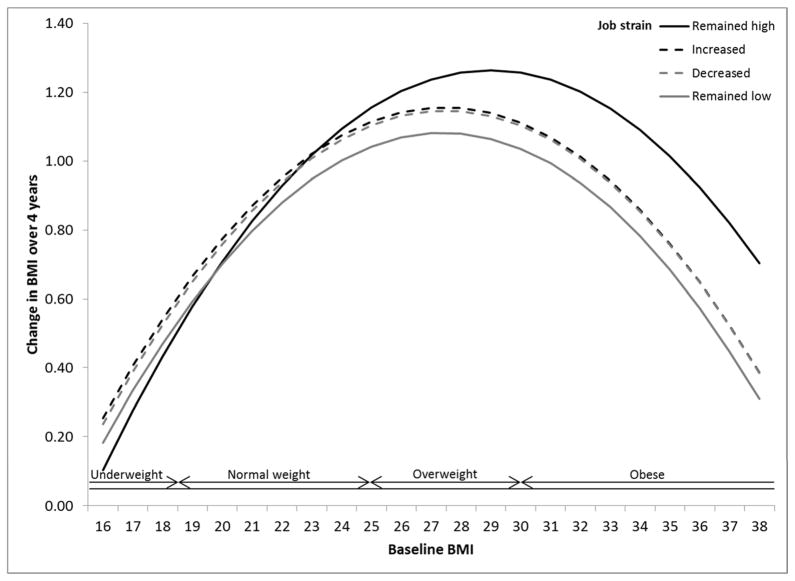
In adjusted models, women who reported high job strain at least once during the four-year period had a greater increase in BMI (ΔBMI=0.06–0.12, p<0.05) than those who never reported high job strain. The association between the change in job strain exposure and the change in BMI depended on the baseline BMI level (p=0.015 for the interaction): the greater the baseline BMI, the greater the BMI gain associated with consistently high job strain. The BMI gain associated with increased or decreased job strain was uniform across the range of baseline BMI.
Conclusions
Women with higher BMI may be more vulnerable to BMI gain when exposed to constant work stress. Future research focusing on mediating mechanisms between job strain and BMI change should explore the possibility of differential responses to job strain by initial BMI.
-
Subjects:
-
Source:Int J Obes (Lond). 39(9):1395-1400.
-
Pubmed ID:25986779
-
Pubmed Central ID:PMC4564350
-
Document Type:
-
Funding:
-
Volume:39
-
Issue:9
-
Collection(s):
-
Main Document Checksum:urn:sha256:a11be4f93f80cbabcd3947e131c6b29451475daa86f81af71d2667e5895d580f
-
Download URL:
-
File Type:
 [PDF
- 446.11 KB
]
[PDF
- 446.11 KB
]
Supporting Files


ON THIS PAGE

CDC STACKS serves as an archival repository of CDC-published products including
scientific findings,
journal articles, guidelines, recommendations, or other public health information authored or
co-authored by CDC or funded partners.
As a repository, CDC STACKS retains documents in their original published format to ensure public access to scientific information.
As a repository, CDC STACKS retains documents in their original published format to ensure public access to scientific information.
You May Also Like
COLLECTION
CDC Public Access