


B cell sub-types following acute malaria and associations with clinical immunity
Supporting Files

-
Mar 03 2016
-
Details
-
Alternative Title:Malar J
-
Personal Author:Sullivan, Richard T. ; Ssewanyana, Isaac ; Wamala, Samuel ; Nankya, Felistas ; Jagannathan, Prasanna ; Tappero, Jordan W. ; Mayanja-Kizza, Harriet ; Muhindo, Mary K. ; Arinaitwe, Emmanuel ; Kamya, Moses ; Dorsey, Grant ; Feeney, Margaret E. ; Riley, Eleanor M. ; Drakeley, Chris J. ; Greenhouse, Bryan ; Sullivan, Richard
-
Description:Background
Repeated exposure to Plasmodium falciparum is associated with perturbations in B cell sub-set homeostasis, including expansion atypical memory B cells. However, B cell perturbations immediately following acute malaria infection have been poorly characterized, especially with regard to their relationship with immunity to malaria.
Methods
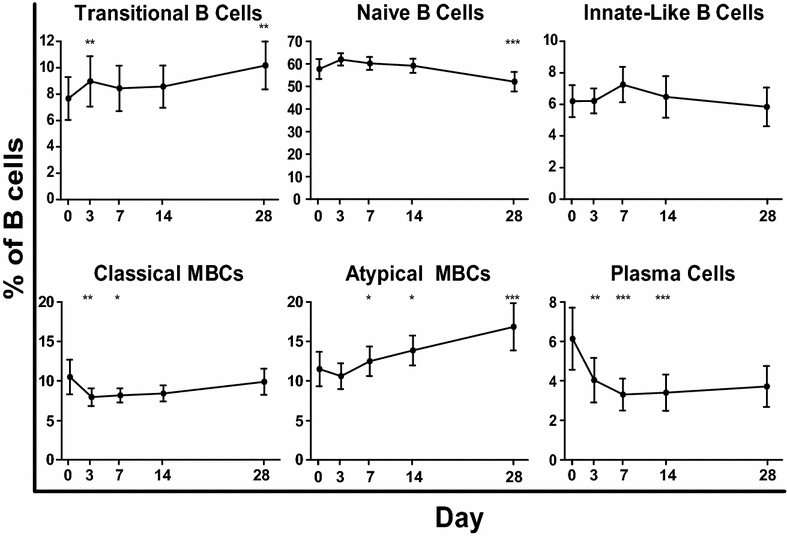
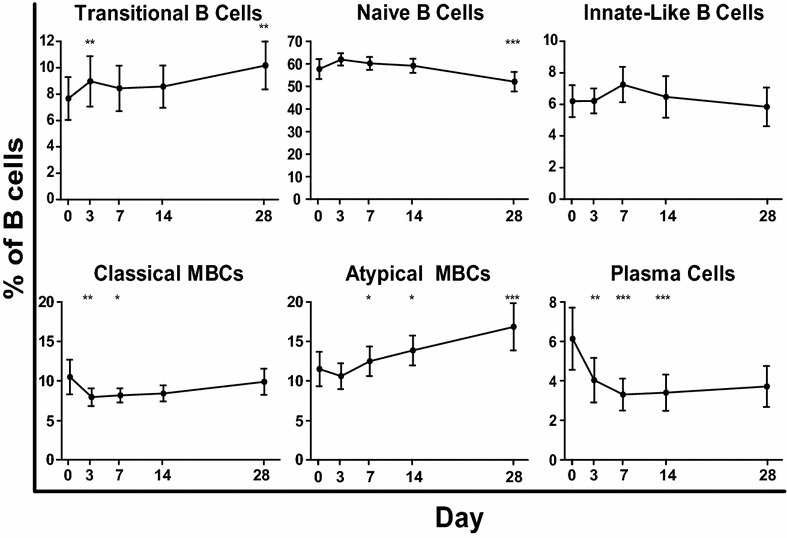
To better understand the kinetics of B cell sub-sets following malaria, the proportions of six B cell sub-sets were assessed at five time points following acute malaria in four to 5 years old children living in a high transmission region of Uganda. B cell sub-set kinetics were compared with measures of clinical immunity to malaria—lower parasite density at the time of malaria diagnosis and recent asymptomatic parasitaemia.
Results
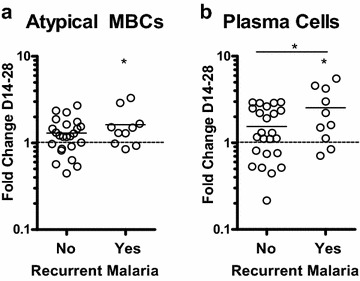
Atypical memory B cell and transitional B cell proportions increased following malaria. In contrast, plasmablast proportions were highest at the time of malaria diagnosis and rapidly declined following treatment. Increased proportions of atypical memory B cells were associated with greater immunity to malaria, whereas increased proportions of transitional B cells were associated with evidence of less immunity to malaria.
Conclusions
These findings highlight the dynamic changes in multiple B cell sub-sets following acute, uncomplicated malaria, and how these sub-sets are associated with developing immunity to malaria.
-
Subjects:
-
Source:Malar J. 15.
-
Pubmed ID:26939776
-
Pubmed Central ID:PMC4778296
-
Document Type:
-
Funding:
-
Volume:15
-
Collection(s):
-
Main Document Checksum:urn:sha256:a1ad386945f8654b565a18ba61a7b0a7836a7ef6800f373b34aa1c4ac2233137
-
Download URL:
-
File Type:
 [PDF
- 1.44 MB
]
[PDF
- 1.44 MB
]
Supporting Files


ON THIS PAGE






CDC STACKS serves as an archival repository of CDC-published products including
scientific findings,
journal articles, guidelines, recommendations, or other public health information authored or
co-authored by CDC or funded partners.
As a repository, CDC STACKS retains documents in their original published format to ensure public access to scientific information.
As a repository, CDC STACKS retains documents in their original published format to ensure public access to scientific information.
You May Also Like
COLLECTION
CDC Public Access