


Three-dimensional computational fluid dynamics modeling of particle uptake by an occupational air sampler using manually-scaled and adaptive grids
Supporting Files

-
Jan 22 2016
Details
-
Alternative Title:J Aerosol Sci
-
Personal Author:
-
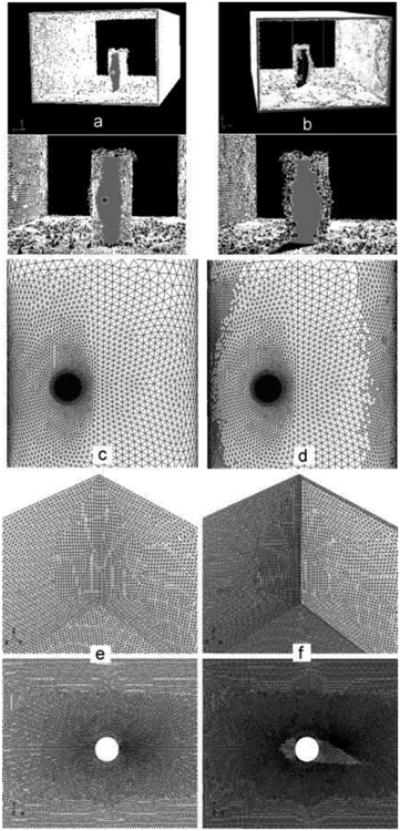
Description:This work presents fluid flow and particle trajectory simulation studies to determine the aspiration efficiency of a horizontally oriented occupational air sampler using computational fluid dynamics (CFD). Grid adaption and manual scaling of the grids were applied to two sampler prototypes based on a 37-mm cassette. The standard k-ε model was used to simulate the turbulent air flow and a second order streamline-upwind discretization scheme was used to stabilize convective terms of the Navier-Stokes equations. Successively scaled grids for each configuration were created manually and by means of grid adaption using the velocity gradient in the main flow direction. Solutions were verified to assess iterative convergence, grid independence and monotonic convergence. Particle aspiration efficiencies determined for both prototype samplers were undistinguishable, indicating that the porous filter does not play a noticeable role in particle aspiration. Results conclude that grid adaption is a powerful tool that allows to refine specific regions that require lots of detail and therefore better resolve flow detail. It was verified that adaptive grids provided a higher number of locations with monotonic convergence than the manual grids and required the least computational effort.
-
Subjects:
-
Source:J Aerosol Sci. 95:54-66.
-
Pubmed ID:26949268
-
Pubmed Central ID:PMC4774053
-
Document Type:
-
Funding:
-
Volume:95
-
Collection(s):
-
Main Document Checksum:urn:sha256:1585d843ef58a9c5c111c9e155168dba0495a99956f3a63f1f9e8a128fa936d9
-
Download URL:
-
File Type:
 [PDF
- 593.68 KB
]
[PDF
- 593.68 KB
]
Supporting Files


ON THIS PAGE



CDC STACKS serves as an archival repository of CDC-published products including
scientific findings,
journal articles, guidelines, recommendations, or other public health information authored or
co-authored by CDC or funded partners.
As a repository, CDC STACKS retains documents in their original published format to ensure public access to scientific information.
As a repository, CDC STACKS retains documents in their original published format to ensure public access to scientific information.
You May Also Like
COLLECTION
CDC Public Access