



Effect of a clinical decision support system on early action on immunological treatment failure in patients with HIV in Kenya: a cluster randomised controlled trial
Supporting Files

-
2 2016
-
Available in CDC Stacks on August 01, 2016, 12:00 AM
File Language:
English
Details
-
Alternative Title:Lancet HIV
-
Personal Author:
-
Description:Background
A clinical decision support system (CDSS) is a computer program that applies a set of rules to data stored in electronic health records to offer actionable recommendations. We aimed to establish whether a CDSS that supports detection of immunological treatment failure among patients with HIV taking antiretroviral therapy (ART) would improve appropriate and timely action.
Methods
We did this prospective, cluster randomised controlled trial in adults and children (aged ≥18 months) who were eligible for, and receiving, ART at HIV clinics in Siaya County, western Kenya. Health facilities were randomly assigned (1:1), via block randomisation (block size of two) with a computer-generated random number sequence, to use electronic health records either alone (control) or with CDSS (intervention). Facilities were matched by type and by number of patients enrolled in HIV care. The primary outcome measure was the difference between groups in the proportion of patients who experienced immunological treatment failure and had a documented clinical action. We used generalised linear mixed models with random effects to analyse clustered data. This trial is registered with ClinicalTrials.gov, number NCT01634802.
Findings
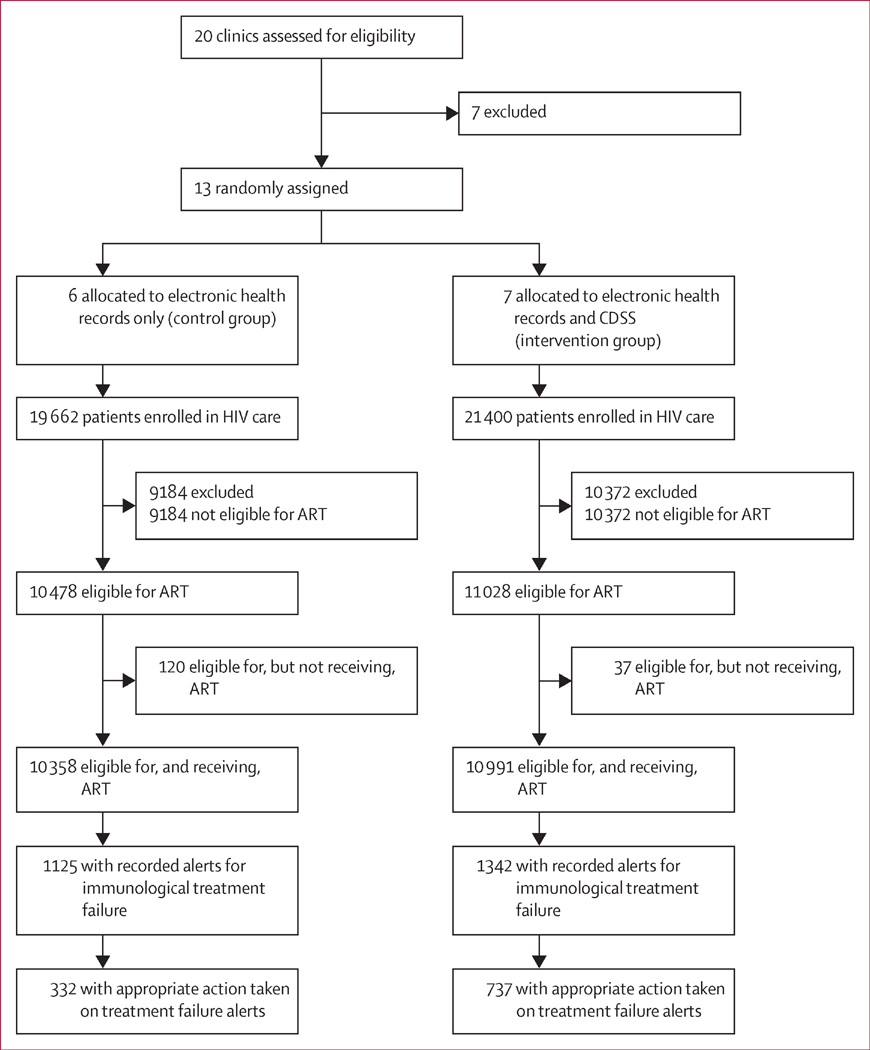
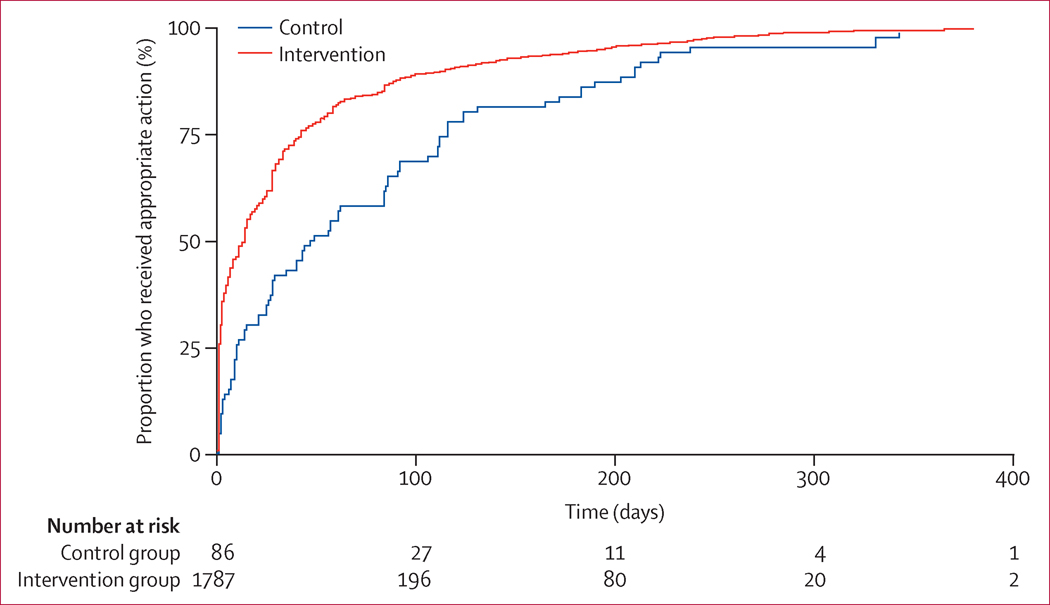
Between Sept 1, 2012, and Jan 31, 2014, 13 clinics, comprising 41 062 patients, were randomly assigned to the control group (n=6) or the intervention group (n=7). Data collection at each site took 12 months. Among patients eligible for ART, 10 358 (99%) of 10 478 patients were receiving ART at control sites and 10 991 (99%) of 11 028 patients were receiving ART at intervention sites. Of these patients, 1125 (11%) in the control group and 1342 (12%) in the intervention group had immunological treatment failure, of whom 332 (30%) and 727 (54%), respectively, received appropriate action. The likelihood of clinicians taking appropriate action on treatment failure was higher with CDSS alerts than with no decision support system (adjusted odds ratio 3.18, 95% CI 1.02–9.87).
Interpretation
CDSS significantly improved the likelihood of appropriate and timely action on immunological treatment failure. We expect our findings will be generalisable to virological monitoring of patients with HIV receiving ART once countries implement the 2015 WHO recommendation to scale up viral load monitoring.
Funding
US President’s Emergency Plan for AIDS Relief (PEPFAR), through the US Centers for Disease Control and Prevention. -
Keywords:
-
Source:Lancet HIV. 3(2):e76-e84
-
Pubmed ID:26847229
-
Pubmed Central ID:PMC4777604
-
Document Type:
-
Funding:
-
Place as Subject:
-
Volume:3
-
Issue:2
-
Download URL:
-
File Type:
 [PDF - 770.72 KB]
 -
Collection(s):
-
Main Document Checksum:urn:sha256:7cd9bc081aff7cf04bf44d427f6d0a40f63ef553e5f4e09a2cffc8938d0b1a78
Supporting Files


File Language:
English
 Was this page helpful?
 Found an issue?



CDC STACKS serves as an archival repository of CDC-published products including
scientific findings, journal articles, guidelines, recommendations, or other public health information authored or
co-authored by CDC or funded partners.
As a repository, CDC STACKS retains documents in their original published format to ensure public access to scientific information.
As a repository, CDC STACKS retains documents in their original published format to ensure public access to scientific information.
You May Also Like
COLLECTION
CDC Public Access