


A longitudinal study of Babesia microti infection in seropositive blood donors
Supporting Files

-
Mar 28 2014
-
Details
-
Alternative Title:Transfusion
-
Personal Author:
-
Description:BACKGROUND
Babesia infection is caused by intraerythrocytic tickborne parasites. Cases of transfusion-transmitted babesiosis have been increasingly recognized. To date, no Babesia test has been licensed for screening US blood donors. We conducted a longitudinal study to assess the course and markers of Babesia infection among seropositive donors identified in a seroprevalence study.
STUDY DESIGN AND METHODS
Eligible donors had B. microti indirect fluorescent antibody (IFA) titers ≥1:64. Enrollees were monitored up to 3 years, by IFA and three methods for evidence of parasitemia: B. microti nested PCR analysis (at two laboratories), hamster inoculation, and blood-smear examination.
RESULTS
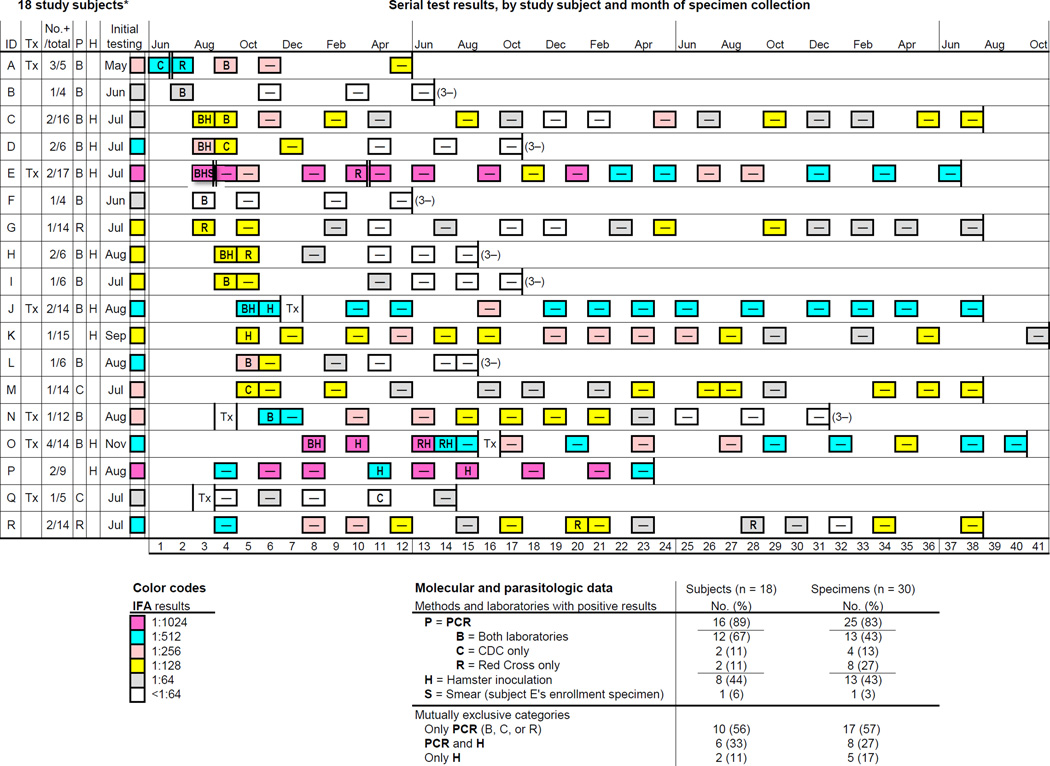
Among 115 eligible donors, 84 (73%) enrolled. Eighteen enrollees (21%) had evidence of parasitemia for 30 total specimens (17% of 181), which were collected in 9 different months and tested positive by various approaches: PCR (25 specimens/16 persons), hamster inoculation (13 specimens/8 persons), and blood smear (1 specimen positive by all three approaches). Overall, 14 persons had ≥1 specimen with positive PCR results at both laboratories (12 persons) and/or had parasitologically confirmed infection (8 persons). Three of nine persons who had >1 specimen with evidence of parasitemia had nonconsecutive positives. Several enrollees likely had been infected ≥1 year when their last positive specimen was collected. The final three specimens for seven persons tested negative by all study methods, including IFA.
CONCLUSION
Seropositive blood donors can have protracted low-level parasitemia that is variably and intermittently detected by parasitologic and molecular methods. Donor-screening algorithms should include serologic testing and not solely rely on molecular testing.
-
Subjects:
-
Source:Transfusion. 54(9):2217-2225.
-
Pubmed ID:24673297
-
Pubmed Central ID:PMC4772885
-
Document Type:
-
Funding:
-
Volume:54
-
Issue:9
-
Collection(s):
-
Main Document Checksum:urn:sha256:e8b0a79087110cdea015b954ed1b84c72ce0ecbb25d2e58e1c907f72862b75f5
-
Download URL:
-
File Type:
 [PDF
- 697.57 KB
]
[PDF
- 697.57 KB
]
Supporting Files


ON THIS PAGE

CDC STACKS serves as an archival repository of CDC-published products including
scientific findings,
journal articles, guidelines, recommendations, or other public health information authored or
co-authored by CDC or funded partners.
As a repository, CDC STACKS retains documents in their original published format to ensure public access to scientific information.
As a repository, CDC STACKS retains documents in their original published format to ensure public access to scientific information.
You May Also Like
COLLECTION
CDC Public Access