


Self-Reported Prevalence of Alcohol Screening Among U.S. Adults
Supporting Files

-
Oct 29 2015
-
File Language:
English
Details
-
Alternative Title:Am J Prev Med
-
Personal Author:
-
Description:Introduction
The U.S. Preventive Services Task Force recommends for adults alcohol screening and brief behavioral counseling interventions in primary care settings. However, there is a paucity of population-based data on the prevalence of alcohol screening. This study examines adherence to this U.S. Preventive Services Task Force recommendation by estimating the prevalence of alcohol screening by demographic characteristics and binge drinking.
Methods
A cross-sectional analysis was conducted in 2013 and 2014 on data from the 2013 fall wave of the ConsumerStyles survey. ConsumerStyles is drawn from an Internet panel randomly recruited by probability-based sampling to be representative of the U.S. population. Data from 2,592 adult respondents who visited primary care physicians in the last year were analyzed to determine the prevalence of alcohol screening.
Results
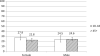
Only 24.7% of respondents reported receiving alcohol screening. The prevalence of screening was similar among women (24.9%) and men (24.5%). Black non-Hispanics reported a significantly lower prevalence of screening than white non-Hispanics (16.2% vs 26.9%, prevalence ratio=0.60, 95% CI=0.40, 0.90). College graduates reported a significantly higher prevalence of screening than respondents with a high school degree or less (28.1% vs 20.8%, prevalence ratio=1.35, 95% CI=1.08, 1.69).
Conclusions
Only about one in four respondents who visited a primary care physician in the last year reported being screened for alcohol misuse. Therefore, many men and women who misuse alcohol are unlikely to be identified. Increased screening may help reduce alcohol misuse and related negative health outcomes.
-
Subjects:
-
Source:Am J Prev Med. 50(3):380-383.
-
Pubmed ID:26520573
-
Pubmed Central ID:PMC4762725
-
Document Type:
-
Funding:
-
Place as Subject:
-
Volume:50
-
Issue:3
-
Collection(s):
-
Main Document Checksum:urn:sha256:4328a2ab9b6f655b9c0d2c75e4b46b1a69921864a7b53ca6eb704dc09ea34b48
-
Download URL:
-
File Type:
 [PDF
- 207.47 KB
]
[PDF
- 207.47 KB
]
Supporting Files


File Language:
English
ON THIS PAGE


CDC STACKS serves as an archival repository of CDC-published products including
scientific findings,
journal articles, guidelines, recommendations, or other public health information authored or
co-authored by CDC or funded partners.
As a repository, CDC STACKS retains documents in their original published format to ensure public access to scientific information.
As a repository, CDC STACKS retains documents in their original published format to ensure public access to scientific information.
You May Also Like
COLLECTION
CDC Public Access