


Acquired resistance to second-line drugs among persons with tuberculosis in the United States
Supporting Files

-
Aug 31 2012
-
File Language:
English
Details
-
Alternative Title:Clin Infect Dis
-
Personal Author:
-
Description:Background
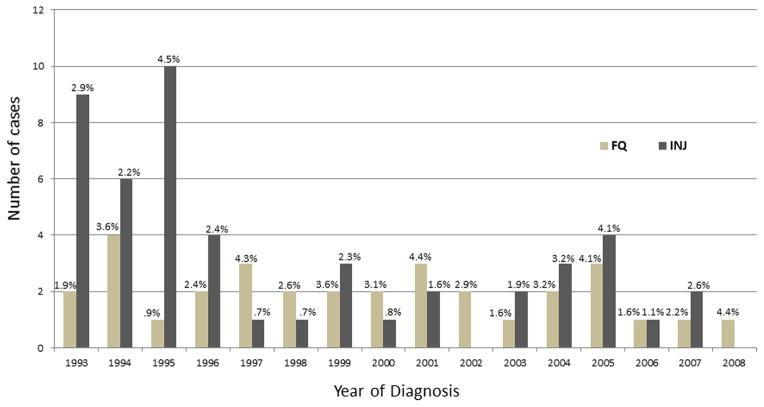
Acquired resistance to second-line drugs (SLD) is a problem in treating patients with drug-resistant tuberculosis (TB) worldwide. The objectives of this study were to identify risk factors for acquired resistance (AR) to injectable SLD and fluoroquinolones in the US National TB Surveillance System, 1993–2008.
Methods
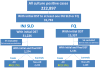
We selected cases with initial and final drug susceptibility test (DST) results reported. We defined AR as resistance at the final DST but susceptibility to the same drug at the initial DST. We analyzed AR using 2-way frequency tables and multivariable logistic regression.
Results
Baseline prevalence of multidrug-resistant (MDR) and extensively drug-resistant (XDR)TB was 12.6% (1864/14,770) and 0.38% (56/14,770), respectively. Of 2,274 individuals without initial resistance to injectable SLD, 49 (2.2%) acquired resistance. Of 1,141 initially susceptible to fluoroquinolones, 32 (2.8%) acquired resistance. AR to injectable SLD was associated with age group 25–44 years (adjusted Odds Ratio [aOR], 2.7; 95% confidence interval [CI], 1.2–6.3), positive HIV status (aOR, 2.5; 95% CI, 1.3–4.7), MDR at treatment initiation (aOR, 5.5; 95% CI, 2.9–10.5), and treatment with any SLD (aOR, 2.4; 95% CI,1.2–4.7). AR to fluoroquinolones was associated with MDR TB at treatment initiation (aOR, 6.5; 95% CI, 2.9–14.6).
Conclusion
Among patients with initial and final DST reported, risk factors for AR to injectable SLD included age, positive HIV status, MDR TB and initial treatment with any SLD, while the only predictor for AR to fluoroquinolones was MDR TB at treatment initiation. Providers should consider monitoring SLD DST for MDR TB patients in the indicated subgroups.
-
Subjects:
-
Source:Clin Infect Dis. 55(12):1600-1607.
-
Pubmed ID:22942206
-
Pubmed Central ID:PMC4758461
-
Document Type:
-
Funding:
-
Place as Subject:
-
Volume:55
-
Issue:12
-
Collection(s):
-
Main Document Checksum:urn:sha256:ff57d9f2bec4316ecdcde505a6dc6440579660190c71ad93cf225b5e361e9e39
-
Download URL:
-
File Type:
 [PDF
- 550.21 KB
]
[PDF
- 550.21 KB
]
Supporting Files


File Language:
English
ON THIS PAGE


CDC STACKS serves as an archival repository of CDC-published products including
scientific findings,
journal articles, guidelines, recommendations, or other public health information authored or
co-authored by CDC or funded partners.
As a repository, CDC STACKS retains documents in their original published format to ensure public access to scientific information.
As a repository, CDC STACKS retains documents in their original published format to ensure public access to scientific information.
You May Also Like
COLLECTION
CDC Public Access