


Interference of Monovalent, Bivalent, and Trivalent Oral Poliovirus Vaccines on Monovalent Rotavirus Vaccine Immunogenicity in Rural Bangladesh
Supporting Files

-
Sep 08 2015
File Language:
English
Details
-
Alternative Title:Clin Infect Dis
-
Personal Author:
-
Description:Background
Trivalent oral poliovirus vaccine (OPV) is known to interfere with monovalent rotavirus vaccine (RV1) immunogenicity. The interference caused by bivalent and monovalent OPV formulations, which will be increasingly used globally in coming years, has not been examined. We conducted a post hoc analysis to assess the effect of coadministration of different OPV formulations on RV1 immunogenicity.
Methods
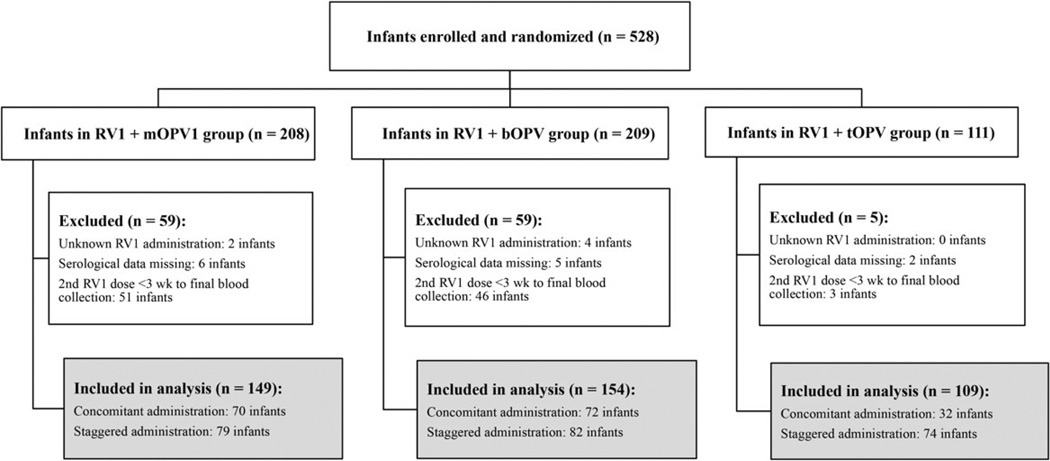
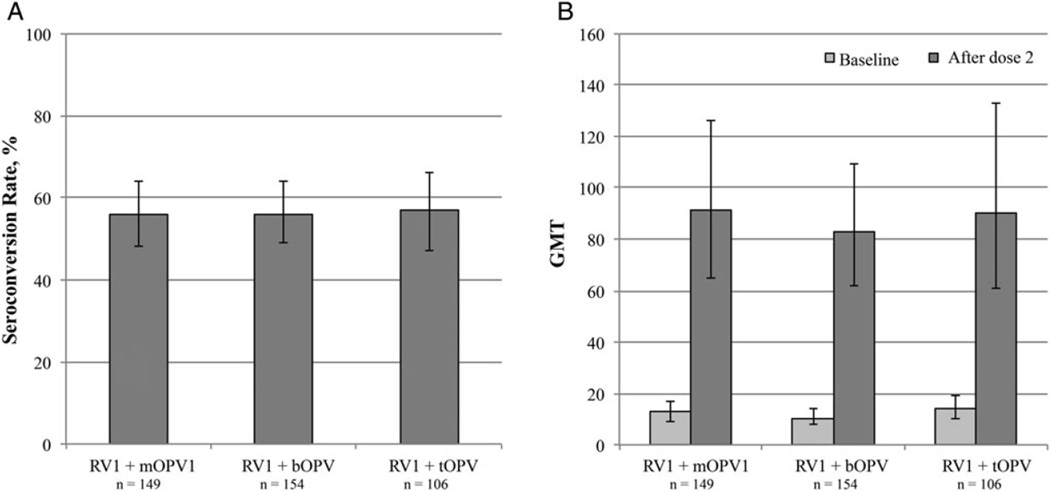
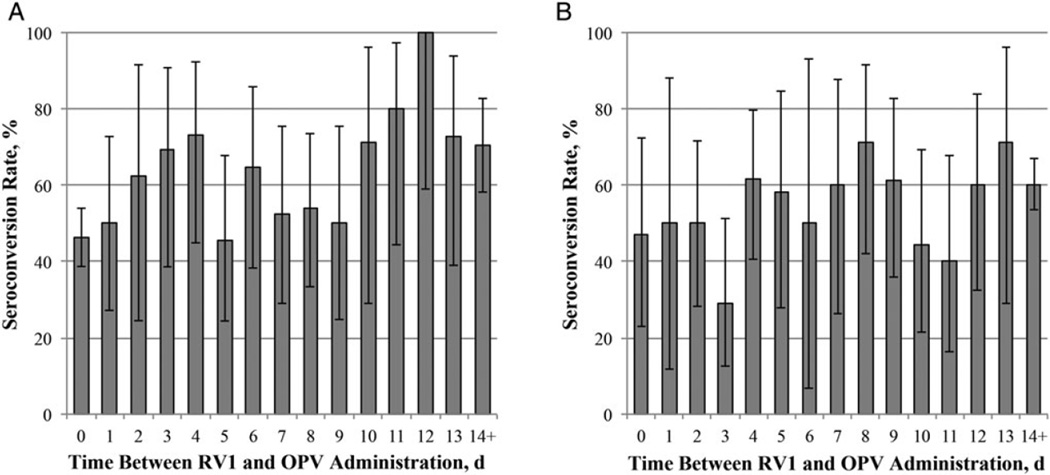
Healthy infants in Matlab, Bangladesh, were randomized to receive 3 doses of monovalent OPV type 1 or bivalent OPV types 1 and 3 at either 6, 8, and 10 or 6, 10, and 14 weeks of age or trivalent OPV at 6, 10, and 14 weeks of age. All infants received 2 doses of RV1 at about 6 and 10 weeks of age. Concomitant administration was defined as RV1 and OPV given on the same day; staggered administration as RV1 and OPV given ≥1 day apart. Rotavirus seroconversion was defined as a 4-fold rise in immunoglobulin A titer from before the first RV1 dose to ≥3 weeks after the second RV1 dose.
Results
There were no significant differences in baseline RV1 immunogenicity among the 409 infants included in the final analysis. Infants who received RV1 and OPV concomitantly, regardless of OPV formulation, were less likely to seroconvert (47%; 95% confidence interval, 39%–54%) than those who received both vaccines staggered ≥1 day (63%; 57%–70%; P < .001). For staggered administration, we found no evidence that the interval between RV1 and OPV administration affected RV1 immunogenicity.
Conclusions
Coadministration of monovalent, bivalent, or trivalent OPV seems to lower RV1 immunogenicity.
Clinical Trials Registration
NCT01633216.
-
Subjects:
-
Source:Clin Infect Dis. 62(2):150-156.
-
Pubmed ID:26349548
-
Pubmed Central ID:PMC4755336
-
Document Type:
-
Funding:
-
Place as Subject:
-
Volume:62
-
Issue:2
-
Collection(s):
-
Main Document Checksum:urn:sha256:f50c18de4922af6ca2b2c8ca1d1c00d2ffa4b78d822f0ce4d217110cf31c614a
-
Download URL:
-
File Type:
 [PDF
- 1.38 MB
]
[PDF
- 1.38 MB
]
Supporting Files


File Language:
English
ON THIS PAGE


CDC STACKS serves as an archival repository of CDC-published products including
scientific findings,
journal articles, guidelines, recommendations, or other public health information authored or
co-authored by CDC or funded partners.
As a repository, CDC STACKS retains documents in their original published format to ensure public access to scientific information.
As a repository, CDC STACKS retains documents in their original published format to ensure public access to scientific information.
You May Also Like
COLLECTION
CDC Public Access