


Maternal Serum 25-Hydroxyvitamin D Concentrations during Pregnancy and Infant Birthweight for Gestational Age: A Three-Cohort Study
Supporting Files

-
Nov 17 2015
-
File Language:
English
Details
-
Alternative Title:Paediatr Perinat Epidemiol
-
Personal Author:
-
Description:Background
In response to inconsistent findings, we investigated associations between maternal serum 25-hydroxyvitamin D (25(OH)D) concentrations and infant birthweight for gestational age (BW/GA), including potential effect modification by maternal race/ethnicity and infant sex.
Methods
Data from 2,558 pregnant women were combined in a nested case-control study (preterm and term) sampled from three cohorts: the Omega study, the Pregnancy, Infection and Nutrition study, and the Pregnancy Outcomes and Community Health study. Maternal 25(OH)D concentrations were sampled at 4 to 29 weeks’ gestation (80% 14–26 weeks). BW/GA was modeled as sex-and gestational age-specific birthweight z-scores. General linear regression models (adjusting for age, education, parity, pre-pregnancy body mass index, season at blood draw, and smoking) assessed 25(OH)D concentrations in relation to BW/GA.
Results
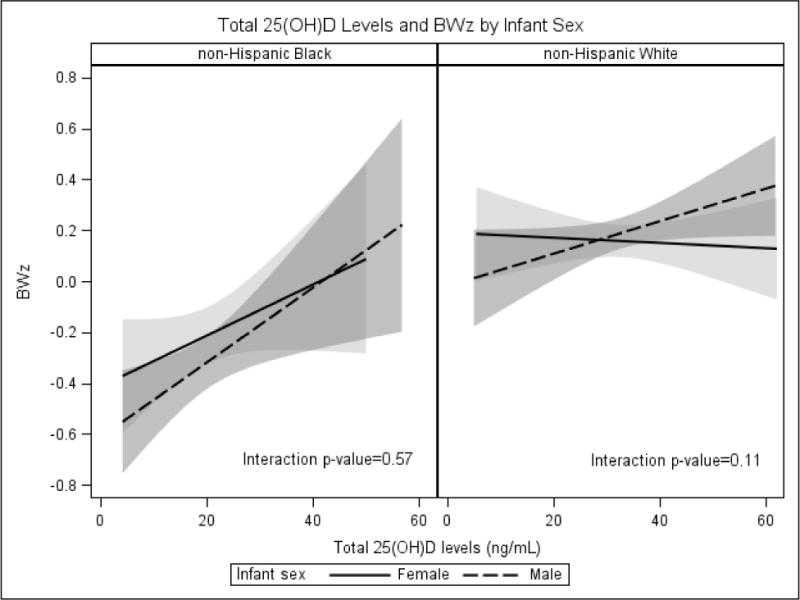
Among non-Hispanic Black women, the positive association between 25(OH)D concentrations and BW/GA was of similar magnitude in pregnancies with female or male infants (beta (β)=0.015, standard error (SE)=0.007, P=0.025; β=0.018, SE=0.006, P=0.003, respectively). Among non-Hispanic White women, 25(OH)D-BW/GA association was observed only with male infants and the effect size was lower (β=0.008, SE=0.003, P=0.02).
Conclusions
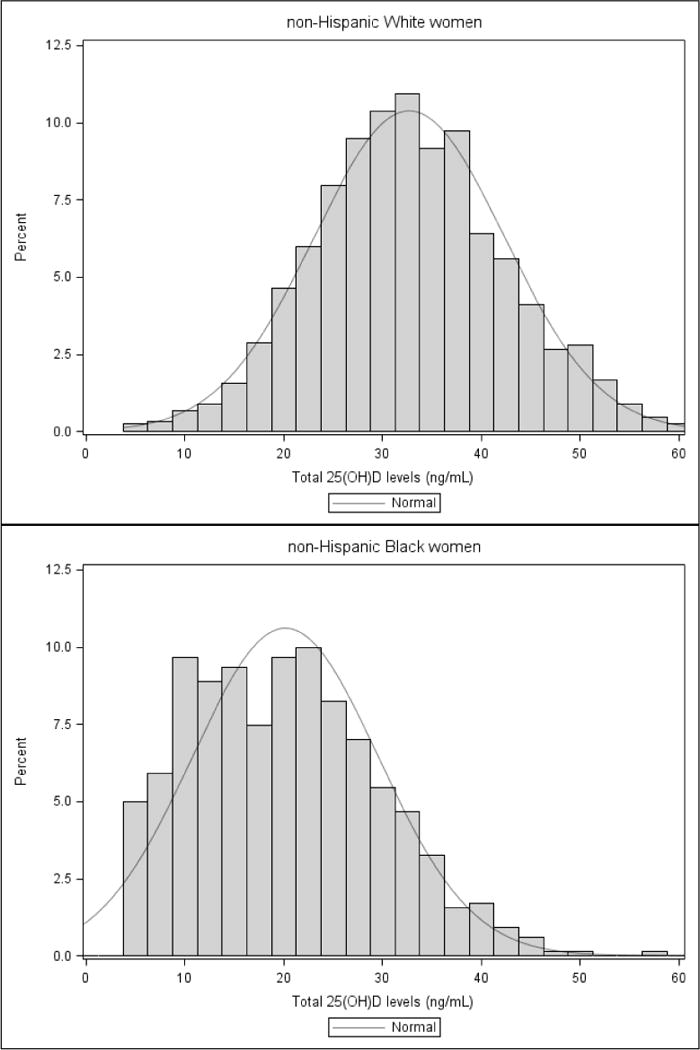
Maternal serum concentrations of 25(OH)D in early and mid-pregnancy were positively associated with BW/GA among non-Hispanic Black male and female infants and non-Hispanic White male infants. Effect modification by race/ethnicity may be due, in part, to overall lower concentrations of 25(OH)D in non-Hispanic Blacks. Reasons for effect modification by infant sex remain unclear.
-
Subjects:
-
Source:Paediatr Perinat Epidemiol. 30(2):124-133.
-
Pubmed ID:26575943
-
Pubmed Central ID:PMC4749469
-
Document Type:
-
Funding:R01 HD34543/HD/NICHD NIH HHS/United States ; M01 RR000046/RR/NCRR NIH HHS/United States ; R01 HD039373/HD/NICHD NIH HHS/United States ; HD28684A/HD/NICHD NIH HHS/United States ; R01 HD034543/HD/NICHD NIH HHS/United States ; RR0046/RR/NCRR NIH HHS/United States ; HD39373/HD/NICHD NIH HHS/United States ; R01 HD32562/HD/NICHD NIH HHS/United States ; R01 HD28684/HD/NICHD NIH HHS/United States ; CC999999/Intramural CDC HHS/United States ; U01 DP000143/DP/NCCDPHP CDC HHS/United States ; R01 HD032562/HD/NICHD NIH HHS/United States ; HD37584/HD/NICHD NIH HHS/United States ; R01 HD037584/HD/NICHD NIH HHS/United States ; R24 HD050924/HD/NICHD NIH HHS/United States ; P2C HD050924/HD/NICHD NIH HHS/United States ; 200-2008-27956-12/PHS HHS/United States
-
Place as Subject:
-
Volume:30
-
Issue:2
-
Collection(s):
-
Main Document Checksum:urn:sha256:b3693159428e295895c9df21b5591cae7cd36e1a750d1125b1c6de909692909b
-
Download URL:
-
File Type:
 [PDF
- 348.47 KB
]
[PDF
- 348.47 KB
]
Supporting Files


File Language:
English
ON THIS PAGE


CDC STACKS serves as an archival repository of CDC-published products including
scientific findings,
journal articles, guidelines, recommendations, or other public health information authored or
co-authored by CDC or funded partners.
As a repository, CDC STACKS retains documents in their original published format to ensure public access to scientific information.
As a repository, CDC STACKS retains documents in their original published format to ensure public access to scientific information.
You May Also Like
COLLECTION
CDC Public Access