


Incidence of End-Stage Renal Disease among Newly Diagnosed Systemic Lupus Erythematosus Patients: The Georgia Lupus Registry
Supporting Files

-
Mar 2016
-
File Language:
English
Details
-
Alternative Title:Arthritis Care Res (Hoboken)
-
Personal Author:
-
Description:Objective
To estimate and identify factors associated with incidence of all-cause end-stage renal disease (ESRD) among newly diagnosed systemic lupus erythematosus (SLE) patients.
Methods
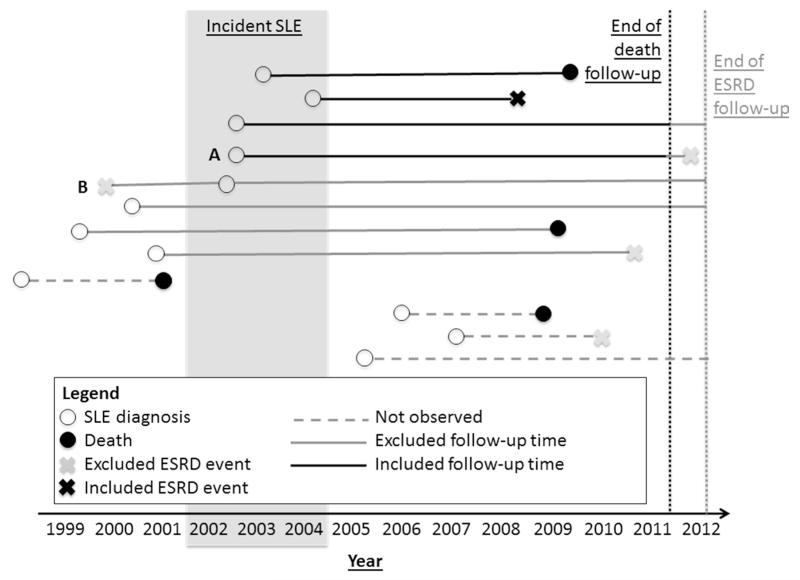
Data from a national registry of treated ESRD were linked to data from a lupus registry of SLE patients who were newly diagnosed and living in Atlanta, Georgia, in 2002-2004 (median follow-up, 7.8 years). Cumulative incidence and incidence rates (ESRD treatment initiations per 1000 patient-years) were calculated, and age- and race-adjusted Poisson models were used to calculate incidence rate ratios (IRRs).
Results
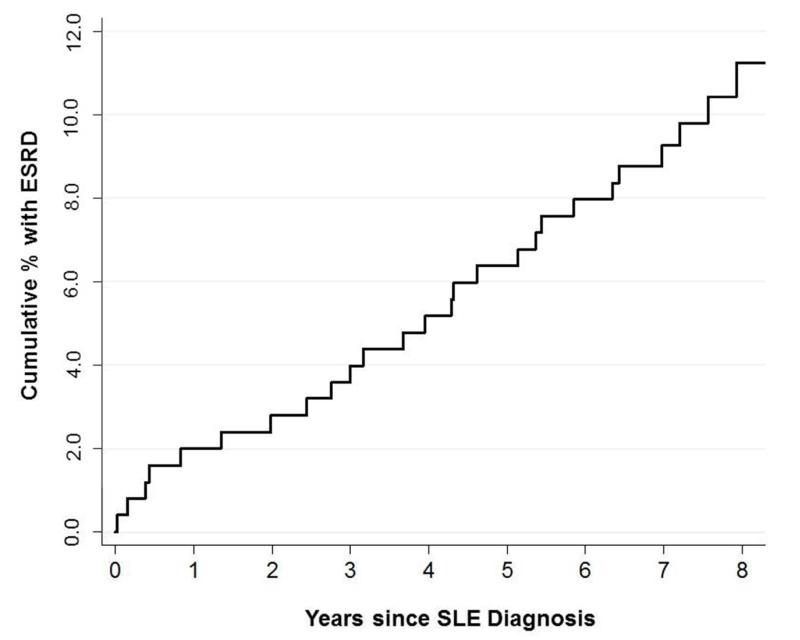
Among 344 newly diagnosed SLE patients, 29 initiated ESRD over 2603.8 years of follow-up. Incidence rates were 13.8 (95% CI, 9.4-20.3) and 3.3 (95% CI, 0.8-13.0) per 1000 patient-years among black and white patients, respectively; corresponding 5-year cumulative incidence was 6.4% and 2.5%. Lupus nephritis documented prior to 2005, which occurred in 80% of those who progressed to ESRD, was the strongest risk factor for incident ESRD (IRR=6.7, 95% CI, 2.7-16.8; incidence rate=27.6 per 1000 patient-years). Results suggested that patients who were black vs. white (IRR=3.9, 95% CI, 0.9-16.4) or <18 years (vs. ≥30 years) at diagnosis (IRR=2.1, 95% CI, 0.9-5.3) may be more likely to progress to ESRD, but incidence did not differ by sex or other characteristics.
Conclusion
Incidence of all-cause ESRD among patients with a recent diagnosis of SLE is high in Georgia. Interventions to decrease ESRD incidence among newly diagnosed SLE patients should target young and black patients as well as patients with lupus nephritis.
-
Subjects:
-
Source:Arthritis Care Res (Hoboken). 68(3):357-365.
-
Pubmed ID:26239749
-
Pubmed Central ID:PMC4740266
-
Document Type:
-
Funding:KL2-TR-000455/TR/NCATS NIH HHS/United States ; CDC-RFA-DP08-806/DP/NCCDPHP CDC HHS/United States ; R01 AR065493/AR/NIAMS NIH HHS/United States ; KL2 TR000455/TR/NCATS NIH HHS/United States ; PA03022/PHS HHS/United States ; R01-AR-065493/AR/NIAMS NIH HHS/United States ; R24 MD008077/MD/NIMHD NIH HHS/United States ; U01-DP-005119/DP/NCCDPHP CDC HHS/United States ; UL1-TR-000454/TR/NCATS NIH HHS/United States ; 1R24MD008077-01/MD/NIMHD NIH HHS/United States ; CC999999/Intramural CDC HHS/United States ; UL1 TR000454/TR/NCATS NIH HHS/United States ; U01 DP005119/DP/NCCDPHP CDC HHS/United States ; R24MD008077-01/MD/NIMHD NIH HHS/United States
-
Place as Subject:
-
Volume:68
-
Issue:3
-
Collection(s):
-
Main Document Checksum:urn:sha256:97b8409cbc8644bbb8c7b33f379e79902bf22400c8f3a5f2783550db7e94d6dd
-
Download URL:
-
File Type:
 [PDF
- 575.92 KB
]
[PDF
- 575.92 KB
]
Supporting Files


File Language:
English
ON THIS PAGE


CDC STACKS serves as an archival repository of CDC-published products including
scientific findings,
journal articles, guidelines, recommendations, or other public health information authored or
co-authored by CDC or funded partners.
As a repository, CDC STACKS retains documents in their original published format to ensure public access to scientific information.
As a repository, CDC STACKS retains documents in their original published format to ensure public access to scientific information.
You May Also Like
COLLECTION
CDC Public Access