


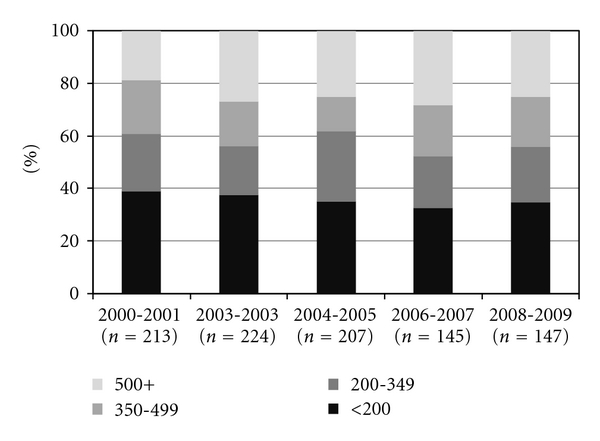
CD4 Cell Counts at HIV Diagnosis among HIV Outpatient Study Participants, 2000–2009
Supporting Files
Public Domain

-
Sep 20 2011
-
Details
-
Alternative Title:AIDS Res Treat
-
Personal Author:
-
Description:Background. It is unclear if CD4 cell counts at HIV diagnosis have improved over a 10-year period of expanded HIV testing in the USA. Methods. We studied HOPS participants diagnosed with HIV infection ≤6 months prior to entry into care during 2000-2009. We assessed the correlates of CD4 count <200 cells/mm(3) at HIV diagnosis (late HIV diagnosis) by logistic regression. Results. Of 1,203 eligible patients, 936 (78%) had a CD4 count within 3 months after HIV diagnosis. Median CD4 count at HIV diagnosis was 299 cells/mm(3) and did not significantly improve over time (P = 0.13). Comparing periods 2000-2001 versus 2008-2009, respectively, 39% and 35% of patients had a late HIV diagnosis (P = 0.34). Independent correlates of late HIV diagnosis were having an HIV risk other than being MSM, age ≥35 years at diagnosis, and being of nonwhite race/ethnicity. Conclusions. There is need for routine universal HIV testing to reduce the frequency of late HIV diagnosis and increase opportunity for patient- and potentially population-level benefits associated with early antiretroviral treatment.
-
Subjects:
-
Source:AIDS Res Treat. 2012; 2012.
-
Document Type:
-
Volume:2012
-
Collection(s):
-
Main Document Checksum:urn:sha-512:da3ea31b04936feda0bc324c6dc35d5cbc9fca3f209e3e328aeb5588fc226dd86caeca723329f7a6eef8a1fc48d053088ab4b5c6c9d87457044c4b40f05255cf
-
Download URL:
-
File Type:
 [PDF
- 525.78 KB
]
[PDF
- 525.78 KB
]
Supporting Files


ON THIS PAGE


CDC STACKS serves as an archival repository of CDC-published products including
scientific findings,
journal articles, guidelines, recommendations, or other public health information authored or
co-authored by CDC or funded partners.
As a repository, CDC STACKS retains documents in their original published format to ensure public access to scientific information.
As a repository, CDC STACKS retains documents in their original published format to ensure public access to scientific information.
You May Also Like
COLLECTION
CDC Public Access