


Malaria Parasitemia among Febrile Patients Seeking Clinical Care at an Outpatient Health Facility in an Urban Informal Settlement Area in Nairobi, Kenya
Supporting Files
Public Domain

-
Nov 23 2015
-
File Language:
English
Details
-
Alternative Title:Am J Trop Med Hyg
-
Personal Author:
-
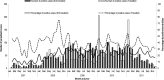
Description:Nairobi is considered a low-risk area for malaria transmission, but travel can influence transmission of malaria. We investigated the demographic characteristics and travel history of patients with documented fever and malaria in a study clinic in a population-based surveillance system over a 5-year period, January 1, 2007 to December 31, 2011. During the study period, 11,480 (68%) febrile patients had a microscopy test performed for malaria, of which 2,553 (22%) were positive. Malaria was detected year-round with peaks in January, May, and September. Children aged 5-14 years had the highest proportion (28%) of positive results followed by children aged 1-4 years (23%). Almost two-thirds of patients with malaria reported traveling outside Nairobi; 79% of these traveled to three counties in western Kenya. History of recent travel (i.e., in past month) was associated with malaria parasitemia (odds ratio: 10.0, 95% confidence interval: 9.0-11.0). Malaria parasitemia was frequently observed among febrile patients at a health facility in the urban slum of Kibera, Nairobi. The majority of patients had traveled to western Kenya. However, 34% reported no travel history, which raises the possibility of local malaria transmission in this densely populated, urban setting. These findings have important implications for malaria control in large Nairobi settlements.
-
Subjects:
-
Source:Am J Trop Med Hyg. 2016; 94(1):122-127.
-
Pubmed ID:26598567
-
Pubmed Central ID:PMC4710415
-
Document Type:
-
Place as Subject:
-
Volume:94
-
Issue:1
-
Collection(s):
-
Main Document Checksum:urn:sha256:4e12981c749e07523d7de52b566664ed08e0194d0783e62c9e713bc936dc924e
-
Download URL:
-
File Type:
 [PDF
- 893.61 KB
]
[PDF
- 893.61 KB
]
Supporting Files


File Language:
English
ON THIS PAGE


CDC STACKS serves as an archival repository of CDC-published products including
scientific findings,
journal articles, guidelines, recommendations, or other public health information authored or
co-authored by CDC or funded partners.
As a repository, CDC STACKS retains documents in their original published format to ensure public access to scientific information.
As a repository, CDC STACKS retains documents in their original published format to ensure public access to scientific information.
You May Also Like
COLLECTION
CDC Public Access