


Considerations for Using Genetic and Epigenetic Information in Occupational Health Risk Assessment and Standard Setting
Supporting Files

-
2015
File Language:
English
Details
-
Alternative Title:J Occup Environ Hyg
-
Personal Author:
-
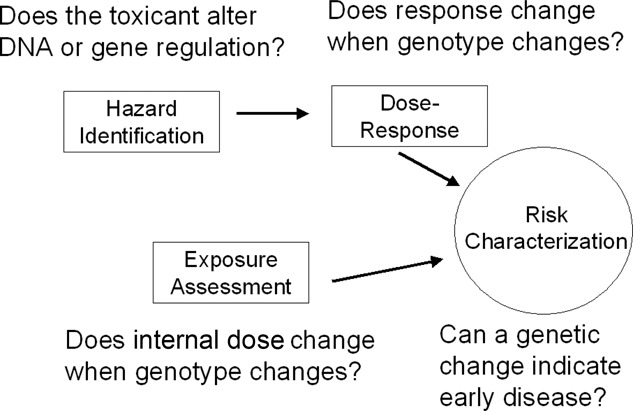
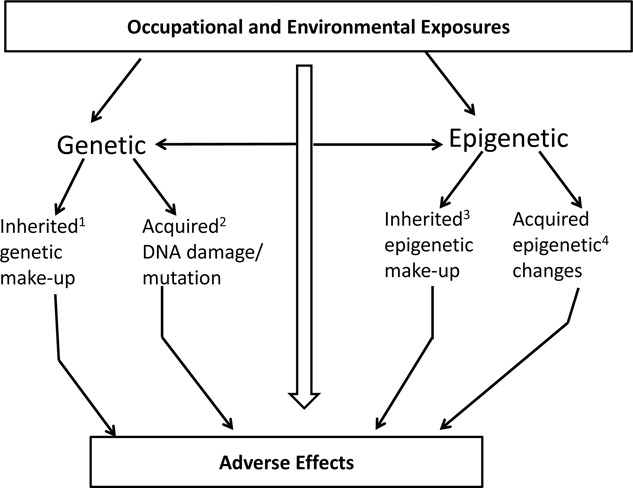
Description:Risk assessment forms the basis for both occupational health decision-making and the development of occupational exposure limits (OELs). Although genetic and epigenetic data have not been widely used in risk assessment and ultimately, standard setting, it is possible to envision such uses. A growing body of literature demonstrates that genetic and epigenetic factors condition biological responses to occupational and environmental hazards or serve as targets of them. This presentation addresses the considerations for using genetic and epigenetic information in risk assessments, provides guidance on using this information within the classic risk assessment paradigm, and describes a framework to organize thinking about such uses. The framework is a 4 × 4 matrix involving the risk assessment functions (hazard identification, dose-response modeling, exposure assessment, and risk characterization) on one axis and inherited and acquired genetic and epigenetic data on the other axis. The cells in the matrix identify how genetic and epigenetic data can be used for each risk assessment function. Generally, genetic and epigenetic data might be used as endpoints in hazard identification, as indicators of exposure, as effect modifiers in exposure assessment and dose-response modeling, as descriptors of mode of action, and to characterize toxicity pathways. Vast amounts of genetic and epigenetic data may be generated by high-throughput technologies. These data can be useful for assessing variability and reducing uncertainty in extrapolations, and they may serve as the foundation upon which identification of biological perturbations would lead to a new paradigm of toxicity pathway-based risk assessments.
-
Subjects:
-
Source:J Occup Environ Hyg. 2015; 12(sup1):S69-S81.
-
Pubmed ID:26583908
-
Pubmed Central ID:PMC4685594
-
Document Type:
-
Funding:
-
Volume:12
-
Collection(s):
-
Main Document Checksum:urn:sha256:36d06eef4f647ebb6ab171e87ae3912281988dbc23dbd123e3e184a13173bc25
-
Download URL:
-
File Type:
 [PDF
- 220.02 KB
]
[PDF
- 220.02 KB
]
Supporting Files


File Language:
English
ON THIS PAGE


CDC STACKS serves as an archival repository of CDC-published products including
scientific findings,
journal articles, guidelines, recommendations, or other public health information authored or
co-authored by CDC or funded partners.
As a repository, CDC STACKS retains documents in their original published format to ensure public access to scientific information.
As a repository, CDC STACKS retains documents in their original published format to ensure public access to scientific information.
You May Also Like
COLLECTION
CDC Public Access