


care products among Californian adults and their children
Supporting Files

-
May 02 2015
-
Details
-
Alternative Title:Environ Res
-
Personal Author:
-
Description:Introduction
Certain phenols and phthalates are used in many consumer products including personal care products (PCPs).
Aims
We aimed to study the associations between the use of PCPs and urinary concentrations of bio-markers of select phenols and phthalates among Californian adults and their children. As an additional aim we compared phenols and phthalate metabolites concentrations measured in adults and children urine samples collected the same day.
Methods
Our study relied on a subsample of 90 adult–child pairs participating in the Study of Use of Products and Exposure Related Behavior (SUPERB). Each adult and child provided one to two urine samples in which we measured concentrations of selected phenols and phthalate metabolites. We computed Spearman correlation coefficients to compare concentrations measured in adults and children urine samples collected the same day. We used adjusted linear and Tobit regression models to study the associations between the use of PCPs in the past 24 h and biomarker concentrations.
Results
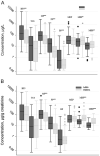
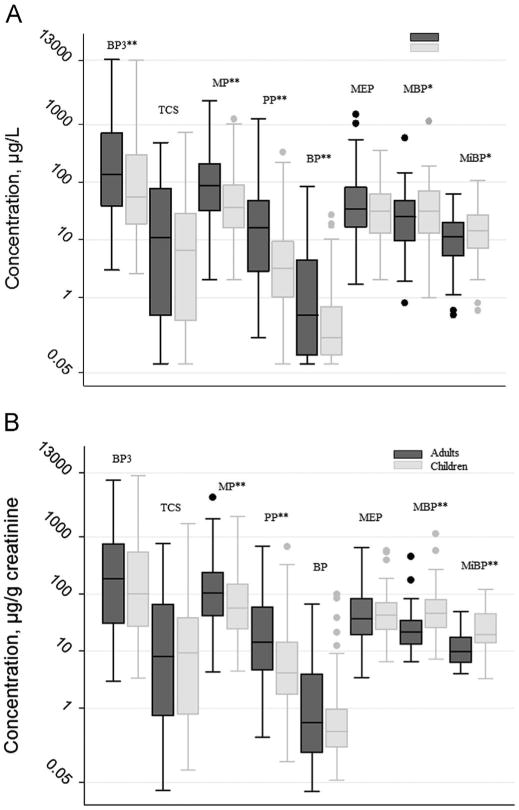
Benzophenone-3 and parabens concentrations were higher in adults compared to their children. Conversely children had higher mono-n-butyl phthalate and mono-isobutyl phthalate concentrations. No significant difference was observed for the other compounds. The total number of different PCPs used was positively associated with urinary concentrations of methyl, propyl and butyl parabens and the main metabolite of diethyl phthalate in adults. Among children, the use of a few specific products including liquid soap, hair care products and sunscreen was positively associated with urinary concentrations of some phenols or phthalate metabolites.
Discussion
These results strengthen the body of evidence suggesting that use of PCPs is an important source of exposure to parabens and diethyl phthalate in adults and provide data on exposure to selected phenols and phthalates through use of PCPs in children.
-
Subjects:
-
Source:Environ Res. 140:369-376.
-
Pubmed ID:25929801
-
Pubmed Central ID:PMC4724203
-
Document Type:
-
Funding:
-
Volume:140
-
Collection(s):
-
Main Document Checksum:urn:sha256:74c2695fb4132d6316e5283482f8fc80eca1c37153e7da02b1e4ed19c1223afb
-
Download URL:
-
File Type:
 [PDF
- 418.59 KB
]
[PDF
- 418.59 KB
]
Supporting Files


ON THIS PAGE

CDC STACKS serves as an archival repository of CDC-published products including
scientific findings,
journal articles, guidelines, recommendations, or other public health information authored or
co-authored by CDC or funded partners.
As a repository, CDC STACKS retains documents in their original published format to ensure public access to scientific information.
As a repository, CDC STACKS retains documents in their original published format to ensure public access to scientific information.
You May Also Like
COLLECTION
CDC Public Access