


The effect of Early Head Start on child welfare system involvement: A first look at longitudinal child maltreatment outcomes☆
Supporting Files

-
7 2014
-
File Language:
English
Details
-
Alternative Title:Child Youth Serv Rev
-
Personal Author:
-
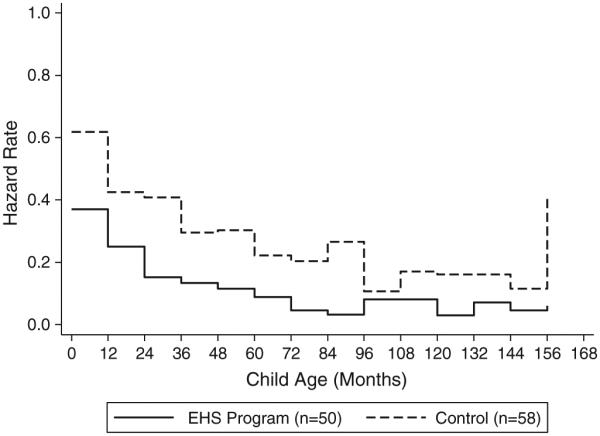
Description:The high societal and personal costs of child maltreatment make identification of effective early prevention programs a high research priority. Early Head Start (EHS), a dual generational program serving low-income families with children prenatally through age three years, is one of the largest federally funded programs for infants and toddlers in the United States. A national randomized trial found EHS to be effective in improving parent and child outcomes, but its effectiveness in reducing child maltreatment was not assessed. The current study used administrative data from state child welfare agencies to examine the impact of EHS on documented abuse and neglect among children from seven of the original seventeen programs in the national EHS randomized controlled trial. Results indicated that children in EHS had significantly fewer child welfare encounters between the ages of five and nine years than did children in the control group, and that EHS slowed the rate of subsequent encounters. Additionally, compared to children in the control group, children in EHS were less likely to have a substantiated report of physical or sexual abuse, but more likely to have a substantiated report of neglect. These findings suggest that EHS may be effective in reducing child maltreatment among low-income children, in particular, physical and sexual abuse.
-
Keywords:
-
Source:Child Youth Serv Rev. 42:127-135
-
Pubmed ID:26744550
-
Pubmed Central ID:PMC4700883
-
Document Type:
-
Funding:
-
Volume:42
-
Collection(s):
-
Main Document Checksum:urn:sha256:d65a7fb8062028274fab5899586079a636549a98f3ef08c2da6acc9676f17e82
-
Download URL:
-
File Type:
 [PDF
- 478.35 KB
]
[PDF
- 478.35 KB
]
Supporting Files


File Language:
English
ON THIS PAGE


CDC STACKS serves as an archival repository of CDC-published products including
scientific findings,
journal articles, guidelines, recommendations, or other public health information authored or
co-authored by CDC or funded partners.
As a repository, CDC STACKS retains documents in their original published format to ensure public access to scientific information.
As a repository, CDC STACKS retains documents in their original published format to ensure public access to scientific information.
You May Also Like
COLLECTION
CDC Public Access