



Searching for maintenance in exercise interventions for cancer survivors
Supporting Files

-
Aug 08 2014
-
Available in CDC Stacks on 2016-01-05T00:00:00Z
Details
-
Alternative Title:J Cancer Surviv
-
Personal Author:
-
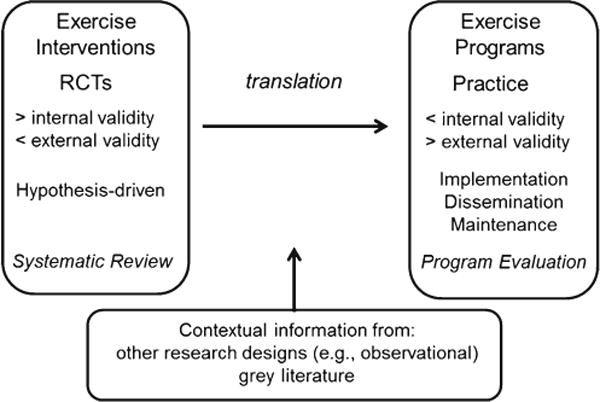
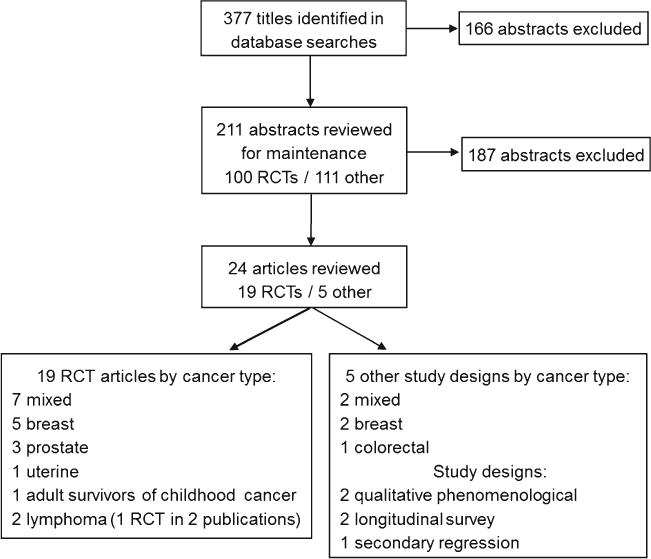
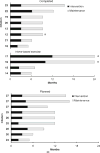
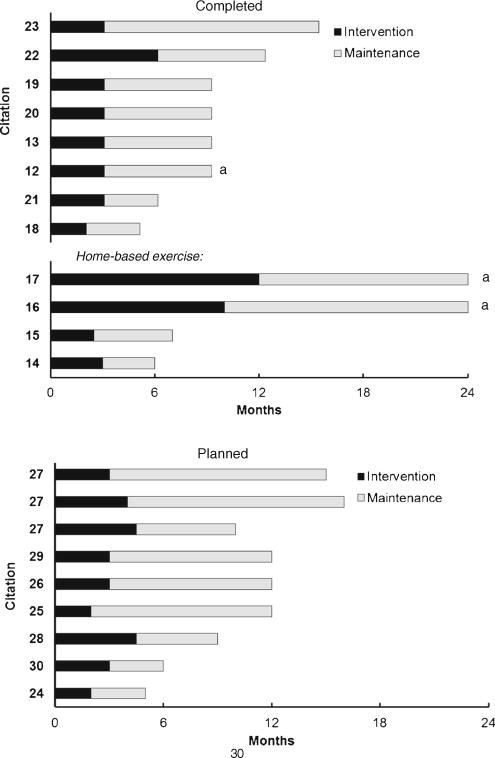
Description:Purpose ; Translating evidence-based exercise interventions into practice is important for expanding the capacity to support cancer survivors. Using the reach, efficacy/effectiveness, adoption, implementation, and maintenance (RE-AIM) framework and scoping study methodology, we addressed the research question, “What is known about the maintenance of exercise interventions for cancer survivors that would inform translation from research to practice and community settings?” Maintenance was investigated at the individual and setting level. ; Methods ; Literature searches were performed in the PubMed, Cumulative Index to Nursing and Allied Health Literature (CINAHL), and Sport Discus databases for articles published from January 2009 to June 2012. Abstracts were judged using a priori criteria for the survivor population, exercise intervention, and maintenance on the individual or setting level. We included completed and planned randomized controlled trials (RCTs) and other study designs. Publications meeting the criteria were reviewed and coded. ; Results ; Of the 211 abstracts meeting patient and exercise criteria, 24 (19 RCTs) met the maintenance criteria. Nine of the 12 completed RCTs demonstrated maintenance of intervention outcomes after 3 to 14 months of follow-up. The planned RCTs described interventions lasting 2 to 4.5 months and maintenance intervals lasting 3 to 12 months following the active intervention. Maintenance at the setting level was reported in one publication. ; Conclusions ; On the individual level, intervention outcomes were maintained in most studies, in a variety of settings and survivor subpopulations. Maintenance on the setting level was scarcely addressed. This scoping study suggests several strategies that could be taken by agencies, clinicians, and researchers to develop more effective and sustainable exercise programs for cancer survivors. ; Implications for Cancer Survivors ; Many benefits of exercise training are maintained for months after cancer survivors complete controlled research studies but relatively little is known about how to translate research to sustainable community-based exercise programs. A better understanding of how programs can be sustained in practice beyond short-term research or grant funding is needed to support a growing number of survivors.
-
Subjects:
-
Source:J Cancer Surviv. 8(4):697-706.
-
Pubmed ID:25103605
-
Pubmed Central ID:PMC4701040
-
Document Type:
-
Funding:
-
Volume:8
-
Issue:4
-
Download URL:
-
File Type:
 [PDF - 259.76 KB]
 -
Collection(s):
-
Main Document Checksum:urn:sha256:5566c37340009c87b97602f699b38094e2ae6abfa9ba23d41f2f06c71d27fb81
Supporting Files


 Was this page helpful?
 Found an issue?

CDC STACKS serves as an archival repository of CDC-published products including
scientific findings, journal articles, guidelines, recommendations, or other public health information authored or
co-authored by CDC or funded partners.
As a repository, CDC STACKS retains documents in their original published format to ensure public access to scientific information.
As a repository, CDC STACKS retains documents in their original published format to ensure public access to scientific information.
You May Also Like
COLLECTION
CDC Public Access