


Personal Breathing Zone Exposures among Hot-Mix Asphalt Paving Workers; Preliminary Analysis for Trends and Analysis of Work Practices That Resulted in the Highest Exposure Concentrations
Supporting Files

-
2013
-
Details
-
Alternative Title:J Occup Environ Hyg
-
Personal Author:
-
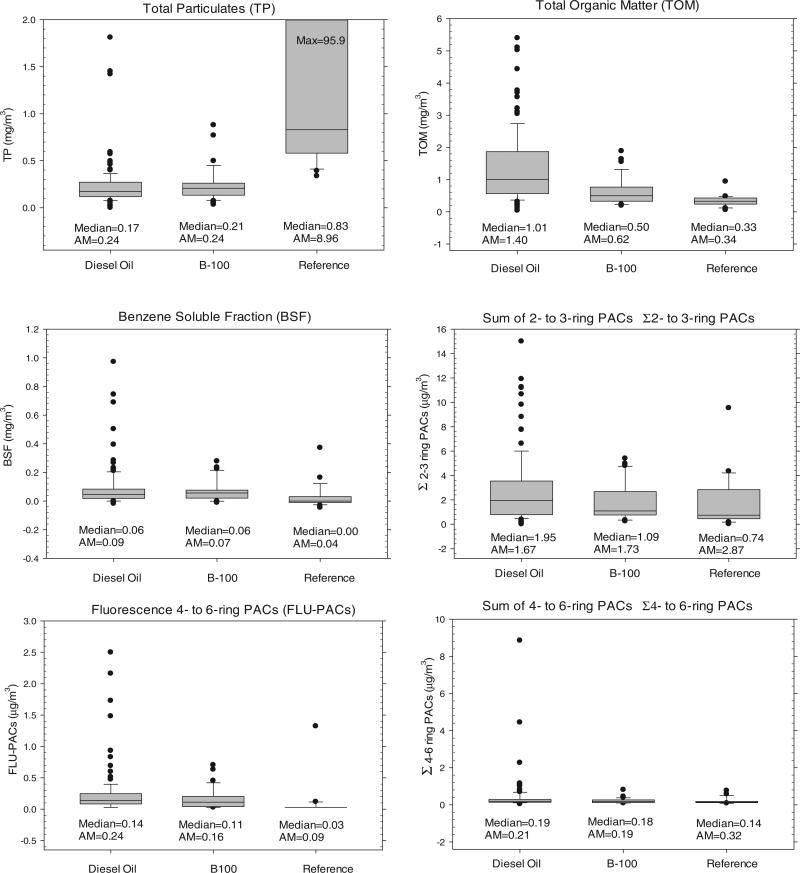
Description:An exposure assessment of hot-mix asphalt (HMA) paving workers was conducted to determine which of four exposure scenarios impacted worker exposure and dose. Goals of this report are to present the personal-breathing zone (PBZ) data, discuss the impact of substituting the releasing/cleaning agent, and discuss work practices that resulted in the highest exposure concentration for each analyte. One-hundred-seven PBZ samples were collected from HMA paving workers on days when diesel oil was used as a releasing/cleaning agent. An additional 36 PBZ samples were collected on days when B-100 (100% biodiesel, containing no petroleum-derived products) was used as a substitute releasing/cleaning agent. Twenty-four PBZ samples were collected from a reference group of concrete workers, who also worked in outdoor construction but had no exposure to asphalt emissions. Background and field blank samples were also collected daily. Total particulates and the benzene soluble fraction were determined gravimetrically. Total organic matter was determined using gas chromatography (GC) with flame ionization detection and provided qualitative information about other exposure sources contributing to worker exposure besides asphalt emissions. Thirty-three individual polycyclic aromatic compounds (PACs) were determined using GC with time-of-flight mass spectrometry; results were presented as either the concentration of an individual PAC or a summation of the individual PACs containing either 2- to 3-rings or 4- to 6-rings. Samples were also screened for PACs containing 4- to 6-rings using fluorescence spectroscopy. Arithmetic means, medians, and box plots of the PBZ data were used to evaluate trends in the data. Box plots illustrating the diesel oil results were more variable than the B-100. Also, the highest diesel oil results were much higher in concentration than the highest B-100 results. An analysis of the highest exposure results and field notes revealed a probable association between these exposures and the use of diesel oil, use of a diesel-powered screed, elevated HMA paving application temperatures, lubricating and working on broken-down equipment, and operation of a broom machine.
-
Subjects:
-
Source:J Occup Environ Hyg. 10(12):663-673.
-
Pubmed ID:24195533
-
Pubmed Central ID:PMC4697931
-
Document Type:
-
Funding:
-
Volume:10
-
Issue:12
-
Collection(s):
-
Main Document Checksum:urn:sha256:8cdc05a6925c9dc4b861926438f98526015d3db41c6c93f518d67021cb4d2510
-
Download URL:
-
File Type:
 [PDF
- 905.43 KB
]
[PDF
- 905.43 KB
]
Supporting Files


ON THIS PAGE


CDC STACKS serves as an archival repository of CDC-published products including
scientific findings,
journal articles, guidelines, recommendations, or other public health information authored or
co-authored by CDC or funded partners.
As a repository, CDC STACKS retains documents in their original published format to ensure public access to scientific information.
As a repository, CDC STACKS retains documents in their original published format to ensure public access to scientific information.
You May Also Like
COLLECTION
CDC Public Access