


Sizing Firefighters: Method and Implications
Supporting Files

-
8 2014
-
File Language:
English
Details
-
Alternative Title:Hum Factors
-
Personal Author:
-
Description:Objective
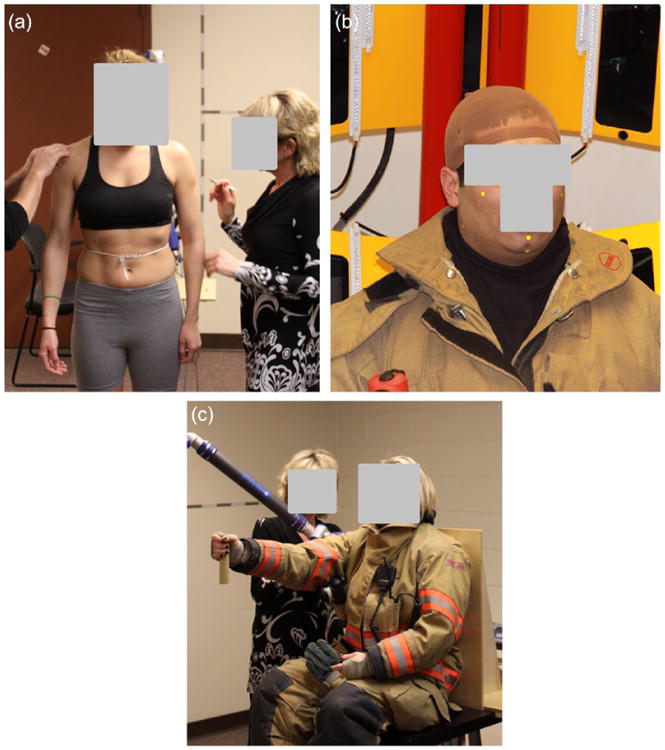
This article reports new anthropometric information of U.S. firefighters for fire apparatus design applications (Study 1) and presents a data method to assist in firefighter anthropometric data usage for research-to-practice propositions (Study 2).
Background
Up-to-date anthropometric information of the U.S. firefighter population is needed for updating ergonomic and safety specifications for fire apparatus.
Method
A stratified sampling plan of three-age by three-race/ethnicity combinations was used to collect anthropometric data of 863 male and 88 female firefighters across the U.S. regions; 71 anthropometric dimensions were measured (Study 1). Differences among original, weighted, and normality transformed data from Study 1 were compared to allowable observer errors (Study 2).
Results
On average, male firefighters were 9.8 kg heavier and female firefighters were 29 mm taller than their counterparts in the general U.S. population. They also have larger upper-body builds than those of the general U.S. population. The data in weighted, unweighted, and normality transformed modes were compatible among each other with a few exceptions.
Conclusion
The data obtained in this study provide the first available U.S. national firefighter anthropometric information for fire apparatus designs. The data represent the demographic characteristics of the current firefighter population and, except for a few dimensions, can be directly employed into fire apparatus design applications without major weighting or nonnormality concerns.
Application
The up-to-date firefighter anthropometric data and data method will benefit the design of future fire apparatus and protective equipment, such as seats, body restraints, cabs, gloves, and bunker gear.
-
Subjects:
-
Keywords:
-
Source:Hum Factors. 56(5):873-910
-
Pubmed ID:25141595
-
Pubmed Central ID:PMC4696393
-
Document Type:
-
Funding:
-
Volume:56
-
Issue:5
-
Collection(s):
-
Main Document Checksum:urn:sha256:de57dfd0f51976a5b95673d773810bfc85334b0314c43dfdaed195bc253b7fa6
-
Download URL:
-
File Type:
 [PDF
- 1.54 MB
]
[PDF
- 1.54 MB
]
Supporting Files


File Language:
English
ON THIS PAGE


CDC STACKS serves as an archival repository of CDC-published products including
scientific findings,
journal articles, guidelines, recommendations, or other public health information authored or
co-authored by CDC or funded partners.
As a repository, CDC STACKS retains documents in their original published format to ensure public access to scientific information.
As a repository, CDC STACKS retains documents in their original published format to ensure public access to scientific information.
You May Also Like
COLLECTION
CDC Public Access