


Metals Exposures of Residents Living Near the Akaki River in Addis Ababa, Ethiopia: A Cross-Sectional Study
Supporting Files
Public Domain

-
Nov 22 2015
-
File Language:
English
Details
-
Alternative Title:J Environ Public Health
-
Personal Author:
-
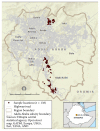
Description:Background. The Akaki River in Ethiopia has been found to contain elevated levels of several metals. Our objectives were to characterize metals exposures of residents living near the Akaki River and to assess metal levels in their drinking water. Methods. In 2011, we conducted a cross-sectional study of 101 households in Akaki-Kality subcity (near the Akaki River) and 50 households in Yeka subcity (distant to the Akaki River). One willing adult in each household provided urine, blood, and drinking water sample. Results. Urinary molybdenum (p < 0.001), tungsten (p < 0.001), lead (p < 0.001), uranium (p < 0.001), and mercury (p = 0.049) were higher in Akaki-Kality participants compared to Yeka participants. Participants in both subcities had low urinary iodine; 45% met the World Health Organization (WHO) classification for being at risk of moderate iodine deficiency. In Yeka, 47% of households exceeded the WHO aesthetic-based reference value for manganese; in Akaki-Kality, only 2% of households exceeded this value (p < 0.001). There was no correlation between metals levels in water samples and clinical specimens. Conclusions. Most of the exposures found during this investigation seem unlikely to cause acute health effects based on known toxic thresholds. However, toxicity data for many of these metals are very limited.
-
Subjects:
-
Source:J Environ Public Health. 2015; 2015.
-
Pubmed ID:26681962
-
Pubmed Central ID:PMC4670646
-
Document Type:
-
Place as Subject:
-
Volume:2015
-
Collection(s):
-
Main Document Checksum:urn:sha256:3b47b1a45dc679f2d0b0846789729165c3ab6fd4ab25c77a83519fe4929b5770
-
Download URL:
-
File Type:
 [PDF
- 1.43 MB
]
[PDF
- 1.43 MB
]
Supporting Files


File Language:
English
ON THIS PAGE



CDC STACKS serves as an archival repository of CDC-published products including
scientific findings,
journal articles, guidelines, recommendations, or other public health information authored or
co-authored by CDC or funded partners.
As a repository, CDC STACKS retains documents in their original published format to ensure public access to scientific information.
As a repository, CDC STACKS retains documents in their original published format to ensure public access to scientific information.
You May Also Like
COLLECTION
CDC Public Access