


Relationship between Use of Labor Pain Medications and Delayed Onset of Lactation
Supporting Files

-
Jan 22 2014
File Language:
English
Details
-
Alternative Title:J Hum Lact
-
Personal Author:
-
Description:Background
Despite estimates that 83% of mothers in the United States receive labor pain medications, little research has been done on how use of these medications affect onset of lactation.
Objective
To investigate whether use of labor pain medications is associated with delayed onset of lactation (DOL).
Methods
We analyzed data from the 2005-2007 Infant Feeding Practices Study II, a longitudinal study of women from late pregnancy through the entire first year after birth (n = 2366). In multivariable logistic regression analyses, we assessed the relationship between mothers’ use of labor pain medication/method and DOL (milk coming in > 3 days after delivery).
Results
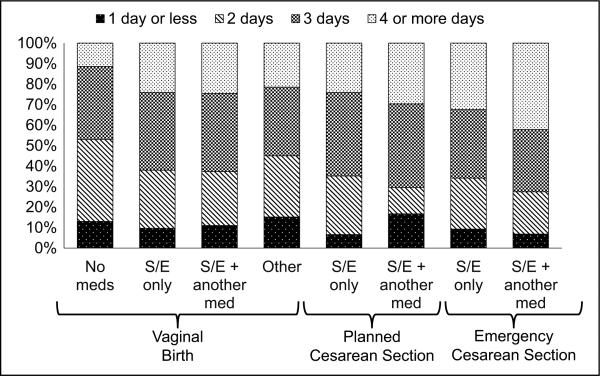
Overall, 23.4% of women in our sample experienced DOL. Compared with women who delivered vaginally and received no labor pain medication, women who received labor pain medications had a higher odds of experiencing DOL: vaginal with spinal/epidural only (aOR 2.05; 95% CI, 1.43-2.95), vaginal with spinal/epidural plus another medication (aOR 1.79; 95% CI, 1.16-2.76), vaginal with other labor pain medications only ([not spinal/epidural]; aOR 1.84; 95% CI, 1.14-2.98), planned cesarean section with spinal/epidural only (aOR 2.13; 95% CI, 1.39-3.27), planned cesarean with spinal/epidural plus another medication (aOR 2.67; 95% CI, 1.35-5.29), emergency cesarean with spinal/epidural only (aOR 2.17; 95% CI, 1.34-3.51), and emergency cesarean with spinal/epidural plus another medication (aOR 3.03; 95% CI, 1.77-5.18).
Conclusion
Mothers who received labor pain medications were more likely to report DOL, regardless of delivery method. This information could help inform clinical decisions regarding labor/delivery.
-
Subjects:
-
Source:J Hum Lact. 30(2):167-173.
-
Pubmed ID:24451212
-
Pubmed Central ID:PMC4684175
-
Document Type:
-
Funding:
-
Place as Subject:
-
Volume:30
-
Issue:2
-
Collection(s):
-
Main Document Checksum:urn:sha256:ad78aa5120c42c870e7e32166f6fdb286616fa416a5bb87679409b7d6ffbf0bb
-
Download URL:
-
File Type:
 [PDF
- 357.86 KB
]
[PDF
- 357.86 KB
]
Supporting Files


File Language:
English
ON THIS PAGE


CDC STACKS serves as an archival repository of CDC-published products including
scientific findings,
journal articles, guidelines, recommendations, or other public health information authored or
co-authored by CDC or funded partners.
As a repository, CDC STACKS retains documents in their original published format to ensure public access to scientific information.
As a repository, CDC STACKS retains documents in their original published format to ensure public access to scientific information.
You May Also Like
COLLECTION
CDC Public Access