


Work Hours and Absenteeism Among Police Officers
Supporting Files

-
2013
-
Details
-
Alternative Title:Int J Emerg Ment Health
-
Personal Author:
-
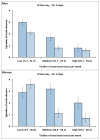
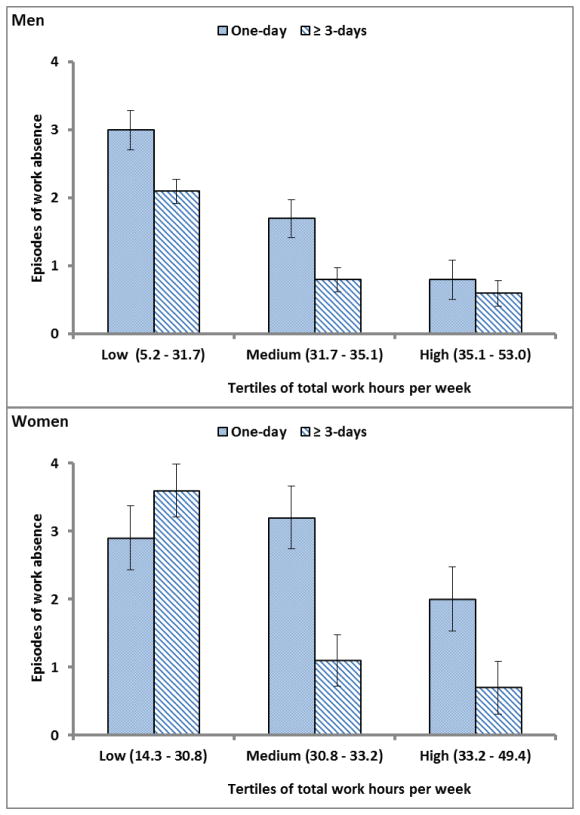
Description:In this study, the cross-sectional association of paid work hours with episodes of work absence was examined in a cohort of police officers. Study subjects were participants from the Buffalo Cardio-Metabolic Occupational Police Stress (BCOPS) study examined between 2004 and 2009. Among 395 study participants with complete data, day-by-day work history records during the one-year period prior to date of examination were used to determine episodes of one-day and three day work absence. The Negative binomial regression analysis was used to examine rate ratios (RR) of work absence. Analyses were also stratified by gender. A one-hour increase in total work hours was associated with 5% reduction in rate of one-day work absence (RR = 0.95, 95% CI: 0.92 - 0.98) and with 8% reduction in rate of three-day work absence (RR = 0.92, 95% CI: 0.89 - 0.95). The association of total work hours with episodes of one-day work absence was significant only in men while the association with episodes of three-day work absence was evident in men and women. In conclusion, in this cohort of police officers, work hours were negatively associated with both durations of work absence (one-day, > or = 3 consecutive days).
-
Subjects:
-
Source:Int J Emerg Ment Health. 15(4):267-276.
-
Pubmed ID:24707589
-
Pubmed Central ID:PMC4676412
-
Document Type:
-
Funding:
-
Volume:15
-
Issue:4
-
Collection(s):
-
Main Document Checksum:urn:sha256:feb859739cc0065bbb06106e7475e4341ca9f7139e22594f6d909ebc9e1b344f
-
Download URL:
-
File Type:
 [PDF
- 381.74 KB
]
[PDF
- 381.74 KB
]
Supporting Files


ON THIS PAGE

CDC STACKS serves as an archival repository of CDC-published products including
scientific findings,
journal articles, guidelines, recommendations, or other public health information authored or
co-authored by CDC or funded partners.
As a repository, CDC STACKS retains documents in their original published format to ensure public access to scientific information.
As a repository, CDC STACKS retains documents in their original published format to ensure public access to scientific information.
You May Also Like
COLLECTION
CDC Public Access