


Clinical epidemiology of the global expansion of Klebsiella pneumoniae carbapenemases
Supporting Files

-
Sep 2013
-
File Language:
English
Details
-
Alternative Title:Lancet Infect Dis
-
Personal Author:Munoz-Price, L Silvia ; Poirel, Laurent ; Bonomo, Robert A ; Schwaber, Mitchell J ; Daikos, George L ; Cormican, Martin ; Cornaglia, Giuseppe ; Garau, Javier ; Gniadkowski, Marek ; Hayden, Mary K ; Kumarasamy, Karthikeyan ; Livermore, David M ; Maya, Juan J ; Nordmann, Patrice ; Patel, Jean B ; Paterson, David L ; Pitout, Johann ; Villegas, Maria Virginia ; Wang, Hui ; Woodford, Neil ; Quinn, John P
-
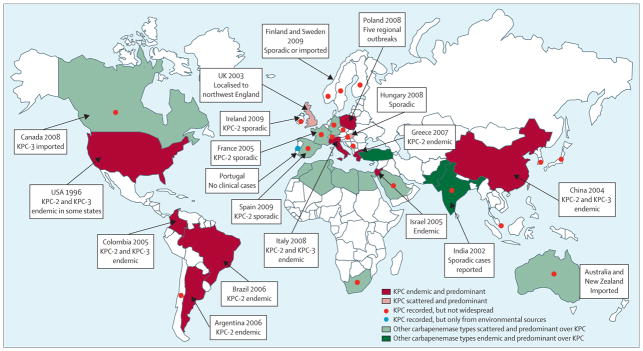
Description:Klebsiella pneumoniae carbapenemases (KPCs) were originally identified in the USA in 1996. Since then, these versatile β-lactamases have spread internationally among Gram-negative bacteria, especially K pneumoniae, although their precise epidemiology is diverse across countries and regions. The mortality described among patients infected with organisms positive for KPC is high, perhaps as a result of the limited antibiotic options remaining (often colistin, tigecycline, or aminoglycosides). Triple drug combinations using colistin, tigecycline, and imipenem have recently been associated with improved survival among patients with bacteraemia. In this Review, we summarise the epidemiology of KPCs across continents, and discuss issues around detection, present antibiotic options and those in development, treatment outcome and mortality, and infection control. In view of the limitations of present treatments and the paucity of new drugs in the pipeline, infection control must be our primary defence for now.
-
Subjects:
-
Source:Lancet Infect Dis. 13(9):785-796
-
Pubmed ID:23969216
-
Pubmed Central ID:PMC4673667
-
Document Type:
-
Funding:
-
Place as Subject:
-
Volume:13
-
Issue:9
-
Collection(s):
-
Main Document Checksum:urn:sha256:9c5cc6ad3290704f4aa9c621c01aba3d35b93ccdf78cc76e25f62f48ac7f1d3b
-
Download URL:
-
File Type:
 [PDF
- 494.34 KB
]
[PDF
- 494.34 KB
]
Supporting Files


File Language:
English
ON THIS PAGE

CDC STACKS serves as an archival repository of CDC-published products including
scientific findings,
journal articles, guidelines, recommendations, or other public health information authored or
co-authored by CDC or funded partners.
As a repository, CDC STACKS retains documents in their original published format to ensure public access to scientific information.
As a repository, CDC STACKS retains documents in their original published format to ensure public access to scientific information.
You May Also Like
COLLECTION
CDC Public Access