


Evaluation of three PCR-based diagnostic assays for detecting mixed Plasmodium infection
Supporting Files
Public Domain

-
Mar 31 2010
Details
-
Alternative Title:BMC Res Notes
-
Personal Author:
-
Description:Background
One of the most commonly used molecular test for malaria diagnosis is the polymerase chain reaction (PCR)-based amplification of the 18S ribosomal DNA (rDNA) gene. Published diagnostic assays based on the 18S gene include the "gold standard" nested assay, semi-nested multiplex assay, and one tube multiplex assay. To our knowledge, no one has reported whether the two multiplex methods are better at detecting mixed Plasmodium infections compared to the nested assay using known quantities of DNA in experimentally mixed cocktails.
Findings
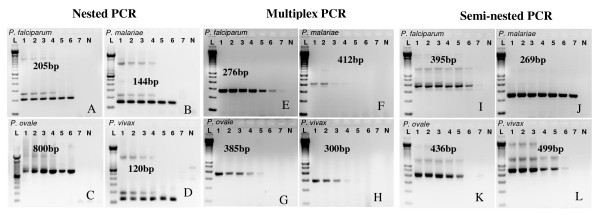
Here we evaluated three PCR assays (nested, semi-nested multiplex, and one-tube multiplex) for the simultaneous detection of human malaria parasites using experimentally mixed cocktails of known quantities of laboratory derived DNA. All three assays detected individual species with high sensitivity and specificity when DNA was from any one single species; however, experimentally mixed DNA cocktails with all four species present were correctly identified most consistently with the nested method. The other two methods failed to consistently identify all four species correctly, especially at lower concentrations of DNA -subclinical levels of malaria (DNA equivalent to or less than 10 parasites per microliter).
Conclusions
The nested PCR method remains the method of choice for the detection of mixed malaria infections and especially of sub-clinical infections. Further optimization and/or new molecular gene targets may improve the success rate of detecting multiple parasite species simultaneously using traditional PCR assays.
-
Subjects:
-
Source:BMC Res Notes. 2010; 3:88.
-
Document Type:
-
Volume:3
-
Collection(s):
-
Main Document Checksum:urn:sha-512:d4c02473aadbf0d0bc6fa9632c960dd1a01c7258a2bde978a3d1839625f789afc832e674b1973945e13b7a74bb550c78b954e8f4f134487bebe740b6ac995e37
-
Download URL:
-
File Type:
 [PDF
- 947.36 KB
]
[PDF
- 947.36 KB
]
Supporting Files


ON THIS PAGE



CDC STACKS serves as an archival repository of CDC-published products including
scientific findings,
journal articles, guidelines, recommendations, or other public health information authored or
co-authored by CDC or funded partners.
As a repository, CDC STACKS retains documents in their original published format to ensure public access to scientific information.
As a repository, CDC STACKS retains documents in their original published format to ensure public access to scientific information.
You May Also Like
COLLECTION
CDC Public Access