


Yellow fever risk assessment in the Central African Republic
Supporting Files

-
10 2014
-
File Language:
English
Details
-
Alternative Title:Trans R Soc Trop Med Hyg
-
Personal Author:
-
Description:Background
Starting in 2008, the Central African Republic (CAR) experienced an unprecedented number of reported yellow fever (YF) cases. A risk assessment of YF virus (YFV) activity was conducted to estimate potential disease risk and vaccine needs.
Methods
A multistage cluster sampling design was used to sample humans, non-human primates, and mosquitoes in distinct ecologic zones. Humans and non-human primates were tested for YFV-specific antibodies; mosquitoes were tested for YFV RNA.
Results
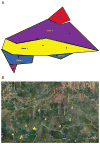
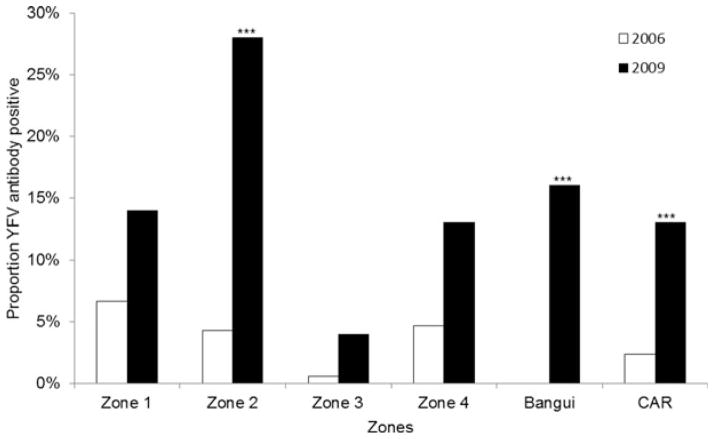
Overall, 13.3% (125/938) of humans were found to have naturally-acquired YFV antibodies. Antibody levels were higher in zones in the southern and south central regions of CAR. All sampled non-human primates (n=56) were known YFV reservoirs; one tested positive for YFV antibodies. Several known YF vectors were identified including Aedes africanus, Ae. aegypti, Ae. luteocephalus, and Ae. simpsoni. Several more urban locations were found to have elevated Breateau and Container indices for Ae. aegypti.
Conclusions
A country-wide assessment of YF risk found YFV to be endemic in CAR. The potential for future YF cases and outbreaks, however, varied by ecologic zone. Improved vaccination coverage through mass campaign and childhood immunization was recommended to mitigate the YF risk.
-
Subjects:
-
Source:Trans R Soc Trop Med Hyg. 108(10):608-615
-
Pubmed ID:24947520
-
Pubmed Central ID:PMC4653062
-
Document Type:
-
Funding:
-
Place as Subject:
-
Volume:108
-
Issue:10
-
Collection(s):
-
Main Document Checksum:urn:sha256:578f1c637513315b5dfed132a86cc61f3e5895f1c8db2e6ad8d707023d690ffb
-
Download URL:
-
File Type:
 [PDF
- 568.32 KB
]
[PDF
- 568.32 KB
]
Supporting Files


File Language:
English
ON THIS PAGE



CDC STACKS serves as an archival repository of CDC-published products including
scientific findings,
journal articles, guidelines, recommendations, or other public health information authored or
co-authored by CDC or funded partners.
As a repository, CDC STACKS retains documents in their original published format to ensure public access to scientific information.
As a repository, CDC STACKS retains documents in their original published format to ensure public access to scientific information.
You May Also Like
COLLECTION
CDC Public Access