


Emergency Hospitalizations for Unsupervised Prescription Medication Ingestions by Young Children
Supporting Files

-
10 2014
-
File Language:
English
Details
-
Alternative Title:Pediatrics
-
Personal Author:
-
Description:Background
Emergency department visits and subsequent hospitalizations of young children following unsupervised ingestions of prescription medications are increasing despite widespread use of child-resistant packaging and caregiver education efforts. Data on the medications implicated in ingestions are limited, but could help identify prevention priorities and intervention strategies.
Methods
We used nationally-representative adverse drug event data from the National Electronic Injury Surveillance System–Cooperative Adverse Drug Event Surveillance project and national retail pharmacy prescription data from IMS Health to estimate the frequency and rates of emergency hospitalizations for unsupervised prescription medication ingestions by young children (2007 through 2011).
Results
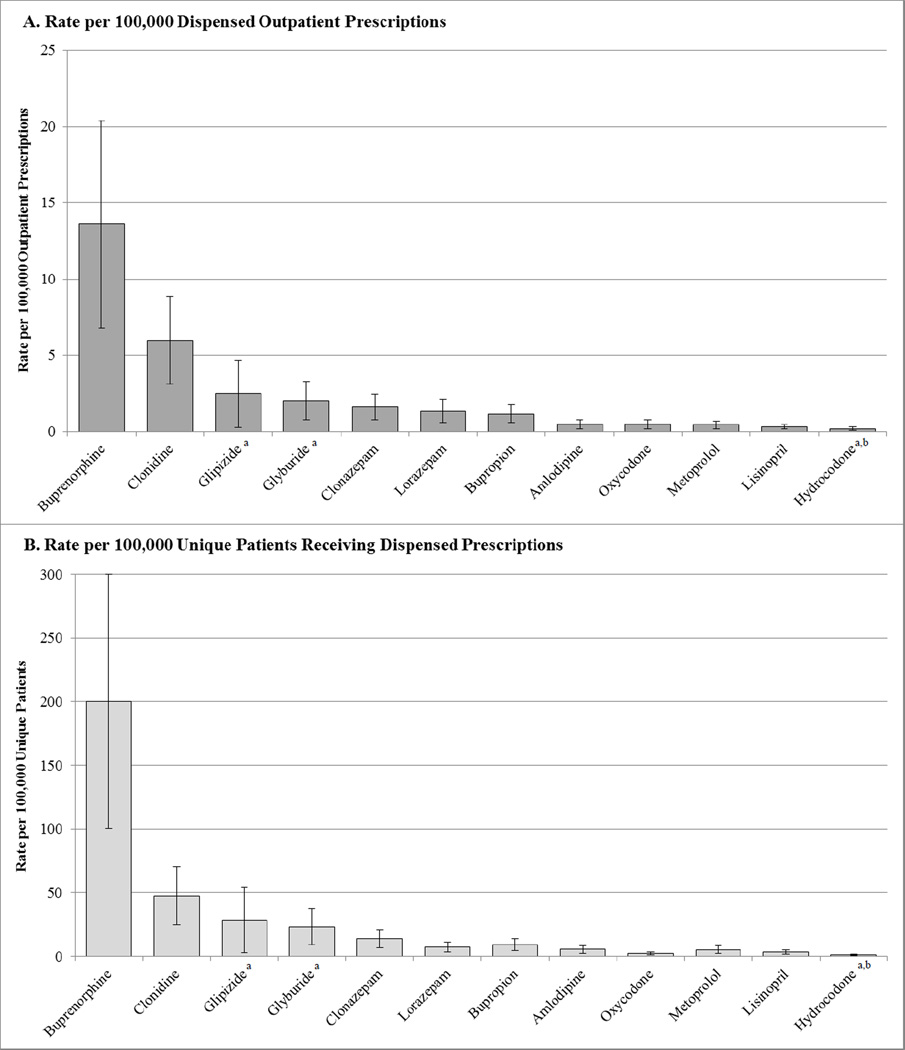
Based on 1,513 surveillance cases, 9,490 estimated emergency hospitalizations (95% confidence interval, 6,420 to 12,560) occurred annually in the United States for unsupervised prescription medication ingestions among children < 6 years from 2007 through 2011; 75.4% involved 1- or 2-year old children. Opioids (17.6%) and benzodiazepines (10.1%) were the most commonly implicated medication classes. The most commonly implicated active ingredients were buprenorphine (7.7%) and clonidine (7.4%). The top twelve active ingredients, alone or in combination with others, were implicated in nearly half (45.0%) of hospitalizations. Accounting for the number of unique patients who received dispensed prescriptions, the hospitalization rate for unsupervised ingestion of buprenorphine products was significantly higher than rates for all other commonly implicated medications and 97-fold higher than the rate for oxycodone products (200.1 vs. 2.1 hospitalizations per 100,000 unique patients).
Conclusions
Focusing unsupervised ingestion prevention efforts on medications with the highest hospitalization rates may efficiently achieve large public health impact.
-
Subjects:
-
Source:Pediatrics. 134(4):e1009-e1016
-
Pubmed ID:25225137
-
Pubmed Central ID:PMC4651431
-
Document Type:
-
Funding:
-
Volume:134
-
Issue:4
-
Collection(s):
-
Main Document Checksum:urn:sha256:d4a7f90767eea6656d6e301ceb90943ec397d7993cbc8e176a7679ec8cfdd431
-
Download URL:
-
File Type:
 [PDF
- 422.00 KB
]
[PDF
- 422.00 KB
]
Supporting Files


File Language:
English
ON THIS PAGE


CDC STACKS serves as an archival repository of CDC-published products including
scientific findings,
journal articles, guidelines, recommendations, or other public health information authored or
co-authored by CDC or funded partners.
As a repository, CDC STACKS retains documents in their original published format to ensure public access to scientific information.
As a repository, CDC STACKS retains documents in their original published format to ensure public access to scientific information.
You May Also Like
COLLECTION
CDC Public Access