


Comorbidities, Smoking Status, and Life Expectancy Among Individuals Eligible for Lung Cancer Screening
Supporting Files

-
Sep 15 2015
-
File Language:
English
Details
-
Alternative Title:Cancer
-
Personal Author:
-
Description:BACKGROUND
Lung cancer screening recommendations are based on results from the National Lung Screening Trial (NLST). The authors determined how the screening-eligible US population differs from NLST participants in terms of characteristics that affect their ability to benefit from screening.
METHODS
The authors identified respondents to the 2012 Health and Retirement Study (HRS), a national survey of individuals aged ≥50 years who are eligible for screening based on US Preventive Services Task Force and Centers for Medicare and Medicaid Services criteria. Comorbidities, life expectancy, smoking history, and other characteristics were compared between the screening-eligible population and NLST participants.
RESULTS
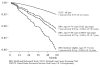
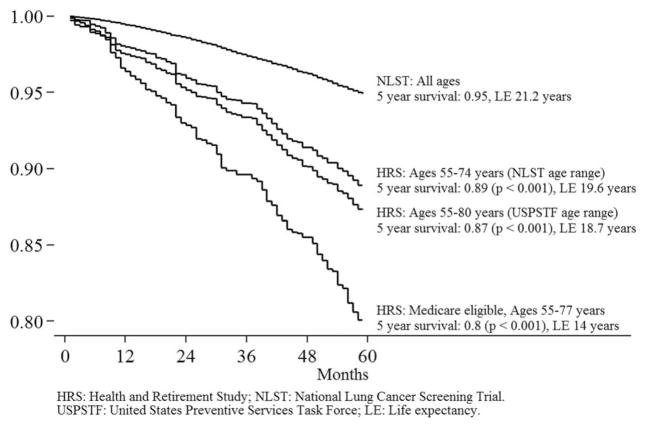
The authors estimated that in 2013, 8.4 million individuals (95% confidence interval, 7.9–8.9 million individuals) would have met the eligibility criteria for lung cancer screening established by the US Preventive Services Task Force. Compared with NLST participants, HRS screening-eligible respondents were older, more likely to be current smokers, and more likely to have been diagnosed with comorbidities. The 5-year survival rate was 87% in the HRS screening-eligible individuals versus 93% in the NLST participants (P<.001, based on a 2-sided test). Life expectancy was 18.7 years in the HRS screening-eligible individuals versus 21.2 years in the NLST participants.
CONCLUSIONS
The US population eligible for lung cancer screening is probably less likely to benefit from early detection than NLST participants because they face a high risk of death from competing causes. The results of the current study highlight the need for smoking cessation interventions targeting those patients eligible for screening and tools to help clinicians determine the potential benefits of screening in individual patients.
-
Subjects:
-
Source:Cancer. 121(24):4341-4347.
-
Pubmed ID:26372542
-
Pubmed Central ID:PMC4670572
-
Document Type:
-
Funding:
-
Place as Subject:
-
Volume:121
-
Issue:24
-
Collection(s):
-
Main Document Checksum:urn:sha256:18e186fe4448536ab0f47872ff430884d7dff4c945f7beb584e956a1e4dd56d0
-
Download URL:
-
File Type:
 [PDF
- 382.25 KB
]
[PDF
- 382.25 KB
]
Supporting Files


File Language:
English
ON THIS PAGE


CDC STACKS serves as an archival repository of CDC-published products including
scientific findings,
journal articles, guidelines, recommendations, or other public health information authored or
co-authored by CDC or funded partners.
As a repository, CDC STACKS retains documents in their original published format to ensure public access to scientific information.
As a repository, CDC STACKS retains documents in their original published format to ensure public access to scientific information.
You May Also Like
COLLECTION
CDC Public Access