



Risk Factors of Loss to Follow up Among HIV Positive Pediatric Patients in Dar es Salaam, Tanzania
Supporting Files

-
11 1 2015 ; 11-1-
-
Available in CDC Stacks on November 01, 2016, 12:00 AM
File Language:
English
Details
-
Alternative Title:J Acquir Immune Defic Syndr
-
Personal Author:
-
Description:Objective
To identify risk factors for loss to follow up (LTFU) in an HIV-infected pediatric population in Dar es Salaam, Tanzania between 2004 and 2011.
Design
Longitudinal analysis of 6236 HIV-infected children.
Methods
We conducted a prospective cohort study of 6236 pediatric patients enrolled in care and treatment in Dar es Salaam from October 2004 to September 2011. LTFU was defined as missing a clinic visit for >90 days for patients on ART and for >180 days for patients in care and monitoring. The relationship of baseline and time-varying characteristics to risk of LTFU was examined using a Cox proportional hazards model.
Results
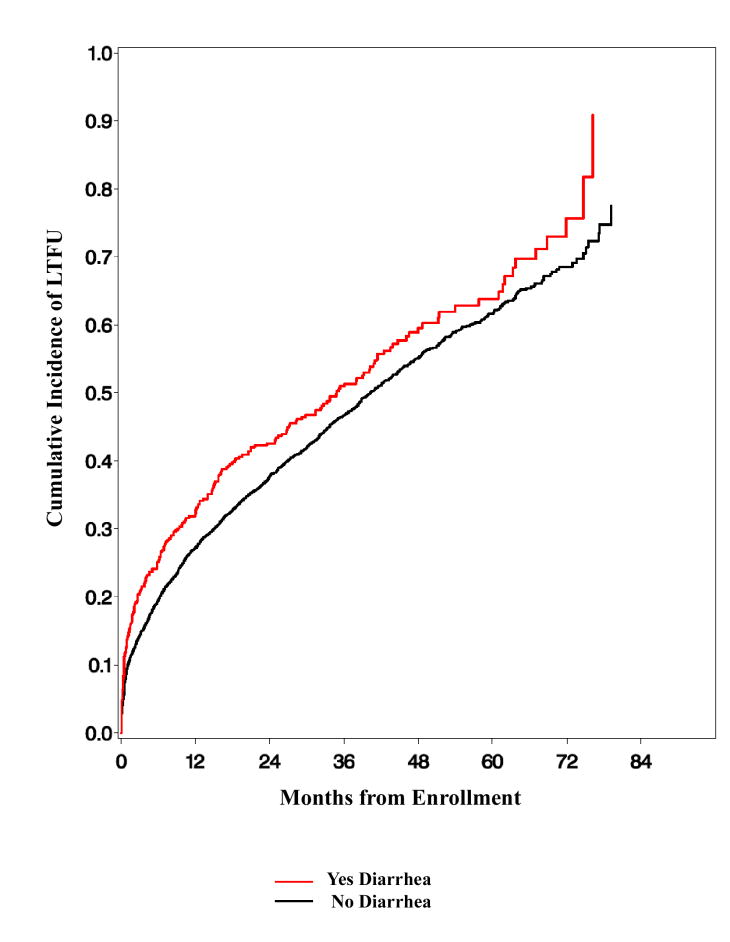
2130 children (34%) were LTFU over a median follow up of 16.7 months (IQR, 3.4–36.9). Factors independently associated with a higher risk of LTFU were age 2 years (RR=1.59, 95% CI 1.40–1.80), diarrhea at enrollment (RR=1.20, 95% CI 1.03–1.41), a low mid-upper arm circumference for age (RR=1.20, CI 1.05–1.37), eating protein 3 times a week (RR=1.39, 95% CI 1.05–1.90), taking cotrimoxazole (RR=1.39, 95% CI 1.06–1.81), initiating onto antiretrovirals (RR=1.37, 95% CI 1.17–1.61), receiving treatment at a hospital instead of a local facility (RR=1.39, 95% CI 1.06–1.41), and starting treatment in 2006 or later (RR=1.10, 95% CI 1.04–1.16).
Conclusions
Health workers should be aware of pediatric patients who are at greatest risk of LTFU, such as younger and undernourished patients, so that they can proactively counsel families about the importance of visit adherence. Findings support decentralization of HIV care to local facilities as opposed to hospitals. -
Keywords:
- Africa
- Tanzania
- antiretroviral therapy
- pediatrics
- HIV/AIDS
- adherence
- Anti-HIV Agents
- Child
- Child Nutritional Physiological Phenomena
- Child, Preschool
- Dietary Proteins
- Female
- HIV Infections
- Humans
- Lost to Follow-Up
- Male
- Malnutrition
- Risk Factors
- Tanzania
- Trimethoprim, Sulfamethoxazole Drug Combination
-
Source:J Acquir Immune Defic Syndr. 70(3):e73-e83
-
Pubmed ID:26247894
-
Pubmed Central ID:PMC4650894
-
Document Type:
-
Funding:K24 HD058795/HD/NICHD NIH HHSUnited States/ ; K24 DK104676/DK/NIDDK NIH HHSUnited States/ ; R01 HD043688-01/HD/NICHD NIH HHSUnited States/ ; U2G PS001966/PS/NCHHSTP CDC HHSUnited States/ ; R01 HD043688/HD/NICHD NIH HHSUnited States/ ; K24HD058795/HD/NICHD NIH HHSUnited States/ ; 5U2GPS001966-04/PHS HHSUnited States/
-
Volume:70
-
Issue:3
-
Download URL:
-
File Type:
 [PDF - 602.38 KB]
 -
Collection(s):
-
Main Document Checksum:urn:sha256:2057df98b73a67a2175c97349330f825a57006596aa977f22808c24b71b08029
Supporting Files


File Language:
English
 Was this page helpful?
 Found an issue?


CDC STACKS serves as an archival repository of CDC-published products including
scientific findings, journal articles, guidelines, recommendations, or other public health information authored or
co-authored by CDC or funded partners.
As a repository, CDC STACKS retains documents in their original published format to ensure public access to scientific information.
As a repository, CDC STACKS retains documents in their original published format to ensure public access to scientific information.
You May Also Like
COLLECTION
CDC Public Access