


Cavity ring-down spectroscopy with an automated control feedback system for investigating nitrate radical surface chemistry reactions
Supporting Files

-
8 2012
File Language:
English
Details
-
Alternative Title:Rev Sci Instrum
-
Personal Author:
-
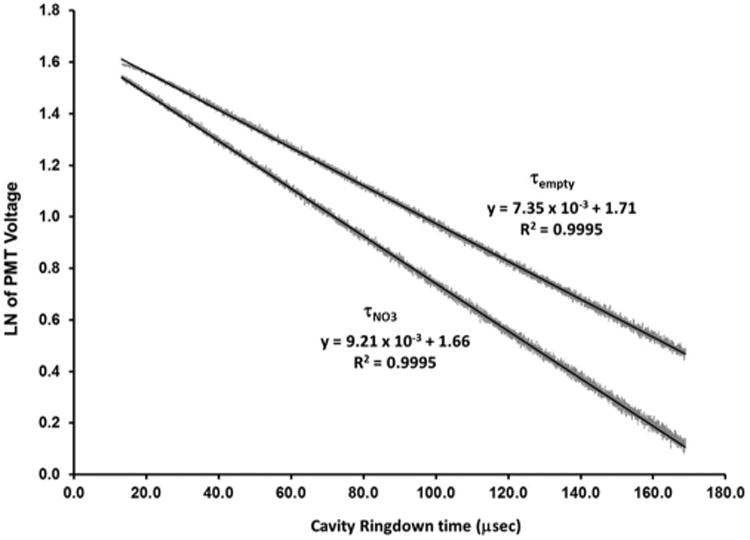
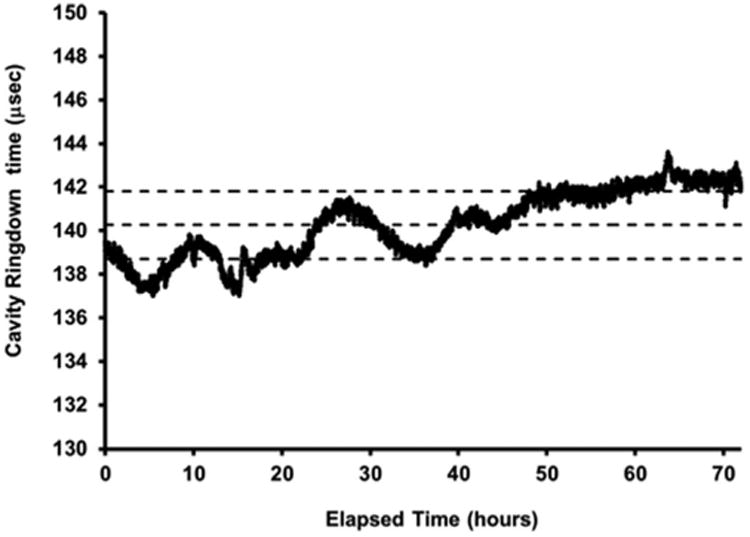
Description:Nitrate radical (NO(3)(●)) surface chemistry of indoor environments has not been well studied due to the difficulty in generating and maintaining NO(3)(●) at low concentrations for long term exposures. This article presents the Surface Chemistry Reactant Air Delivery and Experiment System (SCRADES), a novel feedback controlled system developed to deliver nitrate radicals at specified concentrations (50-500 ppt, ±30 ppt) and flow rates (500-2000 ml min(-1)) to a variety of indoor surfaces to initiate reaction chemistry for periods of up to 72 h. The system uses a cavity ring-down spectrometer (CRDS), with a detection limit of 1.7 ppt, to measure the concentration of NO(3)(●) supplied to a 24 l experiment chamber. Nitrate radicals are introduced via thermal decomposition of N(2)O(5) and diluted with clean dry air until the desired concentration is achieved. Additionally, this article addresses details concerning NO(3)(●) loss through the system, consistency of the NO(3)(●) concentration delivered, and stability of the CRDS cavity over long exposure durations (72 h).
-
Subjects:
-
Source:Rev Sci Instrum. 83(8):085103
-
Pubmed ID:22938328
-
Pubmed Central ID:PMC4643663
-
Document Type:
-
Funding:
-
Volume:83
-
Issue:8
-
Collection(s):
-
Main Document Checksum:urn:sha256:8f0a473af50f5848249bf640b52a532125953c82199e3ea957f522928522cca4
-
Download URL:
-
File Type:
 [PDF
- 646.67 KB
]
[PDF
- 646.67 KB
]
Supporting Files


File Language:
English
ON THIS PAGE



CDC STACKS serves as an archival repository of CDC-published products including
scientific findings,
journal articles, guidelines, recommendations, or other public health information authored or
co-authored by CDC or funded partners.
As a repository, CDC STACKS retains documents in their original published format to ensure public access to scientific information.
As a repository, CDC STACKS retains documents in their original published format to ensure public access to scientific information.
You May Also Like
COLLECTION
CDC Public Access