


Characteristics of hemophilia patients with factor VIII inhibitors detected by prospective screening
Supporting Files

-
10 2015
-
File Language:
English
Details
-
Alternative Title:Am J Hematol
-
Personal Author:
-
Corporate Authors:
-
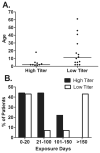
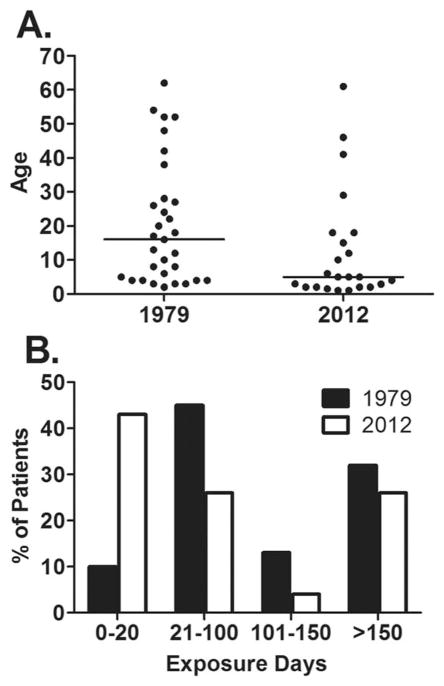
Description:Characteristics of inhibitors identified by prospective screening may differ from those detected clinically. In a prospective study at 17 hemophilia centers with central inhibitor measurement by Nijmegen-Bethesda assay, 23 (2.8%) of 824 hemophilia A patients had new inhibitors detected: nine high-titer inhibitors (HTI: 7 ≥ 5.0 NBU plus 2 of 2.6 and 3.4 NBU at immune tolerance induction initiation) and 14 low-titer inhibitors (LTI: 0.5-1.9 NBU). HTI occurred at an earlier age (median 2 years, range 1-18, vs. median 11 years, range 2-61, P = 0.016). Both HTI (22%) and LTI (43%) occurred in non-severe patients. All HTI, but only 64% of LTI, were found to be FVIII-specific by chromogenic Bethesda assay or fluorescence immunoassay (FLI), indicating a high rate of false-positive LTI. Repeat specimens confirmed all HTI, 7/9 LTI, and 7/7 FVIII-specific LTI. FLI results were similar between HTI and FVIII-specific LTI; all included IgG1 and IgG4 subclasses. A comparable prospective study conducted from 1975 to 1979 at 13 U.S. centers found 31 (2.4%) new inhibitors among 1,306 patients. In both studies, one-third of inhibitors occurred in non-severe patients and one-quarter after 150 exposure days (ED). Significant differences were seen in the age at which inhibitors occurred (median 16 years in the older study vs. 5 years currently, P = 0.024) and in ED before inhibitor development, 10% in the older study and 43% currently study occurring within 20 ED, suggesting a temporal change in inhibitor development. Prospective screening detects inhibitors in patients of all severities, ages, and ED. Some LTI, however, are false positives.
-
Subjects:
-
Source:Am J Hematol. 90(10):871-876
-
Pubmed ID:26147783
-
Pubmed Central ID:PMC4642843
-
Document Type:
-
Funding:
-
Volume:90
-
Issue:10
-
Collection(s):
-
Main Document Checksum:urn:sha256:45edc3ab17f9a5c7e3b101b4ad66c354845ee9f2b4ee5edd60f9cb6c4af45089
-
Download URL:
-
File Type:
 [PDF
- 391.88 KB
]
[PDF
- 391.88 KB
]
Supporting Files


File Language:
English
ON THIS PAGE



CDC STACKS serves as an archival repository of CDC-published products including
scientific findings,
journal articles, guidelines, recommendations, or other public health information authored or
co-authored by CDC or funded partners.
As a repository, CDC STACKS retains documents in their original published format to ensure public access to scientific information.
As a repository, CDC STACKS retains documents in their original published format to ensure public access to scientific information.
You May Also Like
COLLECTION
CDC Public Access