


Fusion with extracellular domain of cytotoxic T-lymphocyte-associated-antigen 4 leads to enhancement of immunogenicity of Hantaan virus DNA vaccines in C57BL/6 mice
Supporting Files
Public Domain

-
Sep 23 2011
-
File Language:
English
Details
-
Alternative Title:Virol J
-
Personal Author:
-
Description:Background
Hantaan virus (HTNV) is the causative agent of the most severe form of a rodent-borne disease known as hemorrhagic fever with renal syndrome (HFRS). A safe and effective HTNV vaccine is needed. Vaccination with DNA constructs expressing fused antigen with bioactive factors, has shown promising improvement of immunogenicity for viral agents in animal models, but the effect of fusion strategy on HTNV DNA vaccine has not been investigated.
Results
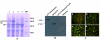
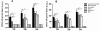
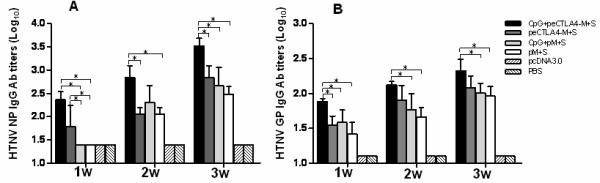
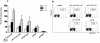
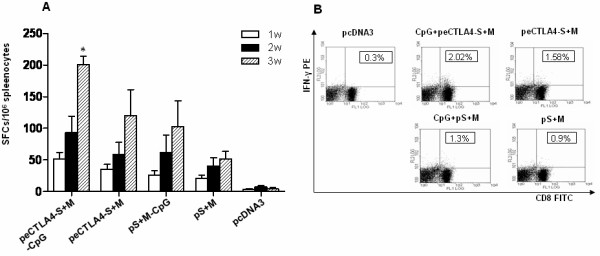
DNA plasmids encoding the HTNV nucleocapsid protein (N) and glycoprotein (Gn and Gc) in fusion to the extracellular domain of cytotoxic T-lymphocyte-associated-antigen 4 (eCTLA-4) targeting to antigen presenting cells (APCs) were constructed. Intramuscular immunization of mice with plasmids expressing eCTLA-4-HTNV-N/GP fusion proteins leads to a significant enhancement of the specific antibody response as well as cytotoxic T-lymphocyte (CTL) response in C57BL/6 mice. Moreover, this effect could be further augmented when co-administered with CpG motifs.
Conclusions
Modification of viral antigen in fusion to bioactive factor will be promising to confer efficient antigen presentation and improve the potency of DNA vaccine in mice.
-
Subjects:
-
Source:Virol J. 2011; 8:448.
-
Document Type:
-
Volume:8
-
Collection(s):
-
Main Document Checksum:urn:sha-512:0902e3a958f960722e894b3ce7d163ef97fe59885b23e909a2a4ba07ca07018193cd19abe00b42398be47be794265c0b4597be6fc7e2c87f2174ac01d92c2e3d
-
Download URL:
-
File Type:
 [PDF
- 682.48 KB
]
[PDF
- 682.48 KB
]
Supporting Files


File Language:
English
ON THIS PAGE


CDC STACKS serves as an archival repository of CDC-published products including
scientific findings,
journal articles, guidelines, recommendations, or other public health information authored or
co-authored by CDC or funded partners.
As a repository, CDC STACKS retains documents in their original published format to ensure public access to scientific information.
As a repository, CDC STACKS retains documents in their original published format to ensure public access to scientific information.
You May Also Like
COLLECTION
CDC Public Access