



Increased Decline in Pulmonary Function Among Employees in Norwegian Smelters Reporting Work-Related Asthma-Like Symptoms
Supporting Files

-
Sep 2015
-
Available in CDC Stacks on 2015-11-30T00:00:00Z
Details
-
Alternative Title:J Occup Environ Med
-
Personal Author:
-
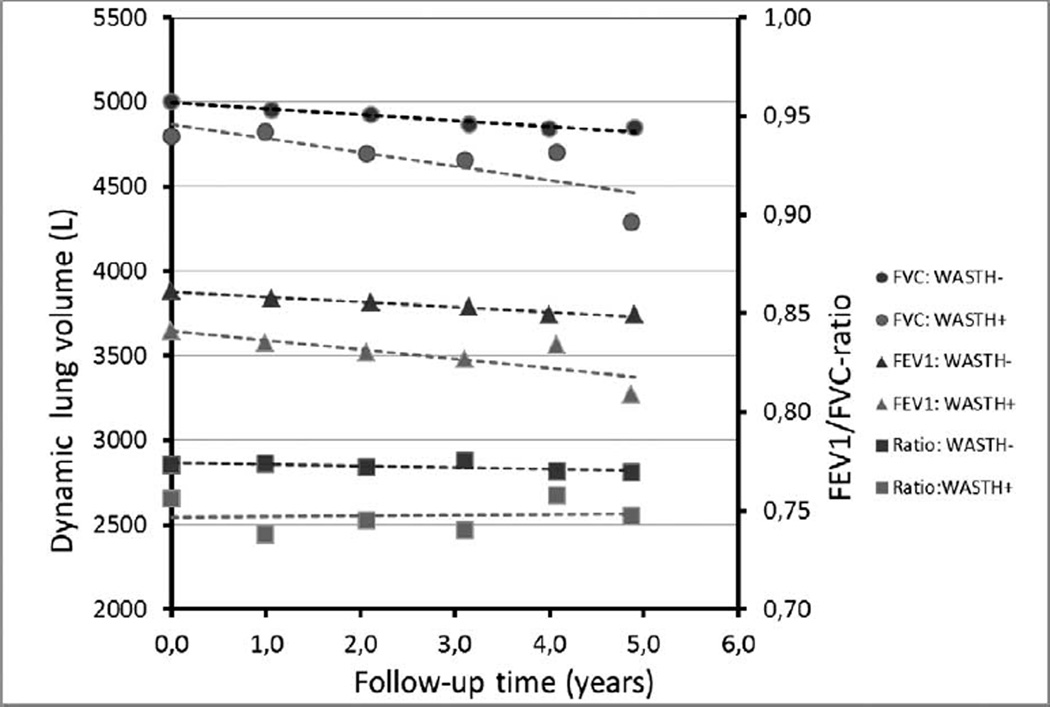
Description:Objective ; To investigate associations between work-related asthma-like symptoms (WASTH) and annual pulmonary function decline among employees of 18 Norwegian smelters. ; Methods ; A 5-year longitudinal study in which WASTH was defined as a combination of dyspnea and wheezing that improved on rest days and vacation. ; Results ; A total of 12,966 spirometry examinations were performed in 3084 employees. Crude annual decline in forced expiratory volume in 1 second (FEV1) (dFEV1) was 32.9 mL/yr (95% confidence interval, 30.5 to 35.3), and crude annual decline in forced vital capacity (FVC) (dFVC) was 40.9 mL/yr (37.8 to 43.9). After adjustment for relevant covariates, employees reporting WASTH showed higher dFEV1 by 16.0 m:/yr (3.4 to 28.6) and higher dFVC by 20.5 mL/yr (6.0 to 35.0) compared with employees not reporting WASTH. ; Conclusion ; Work-related asthma-like symptom was associated with greater annual declines in FEV1 and FVC, indicating a restrictive pattern.
-
Subjects:
-
Source:J Occup Environ Med. 57(9):1004-1008.
-
Pubmed ID:26340289
-
Pubmed Central ID:PMC4664453
-
Document Type:
-
Funding:
-
Volume:57
-
Issue:9
-
Download URL:
-
File Type:
 [PDF - 592.59 KB]
 -
Collection(s):
-
Main Document Checksum:urn:sha256:94afa4c92c8d9d20d4522ecb555eec2286f7c4a5598666e12361e48f0816f93d
Supporting Files


 Was this page helpful?
 Found an issue?


CDC STACKS serves as an archival repository of CDC-published products including
scientific findings, journal articles, guidelines, recommendations, or other public health information authored or
co-authored by CDC or funded partners.
As a repository, CDC STACKS retains documents in their original published format to ensure public access to scientific information.
As a repository, CDC STACKS retains documents in their original published format to ensure public access to scientific information.
You May Also Like
COLLECTION
CDC Public Access