


Regional Variations in Home Canning Practices and the Risk of Foodborne Botulism in the Republic of Georgia, 2003
Supporting Files

-
Apr 2015
-
File Language:
English
Details
-
Alternative Title:J Food Prot
-
Personal Author:
-
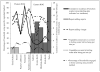
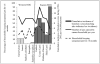
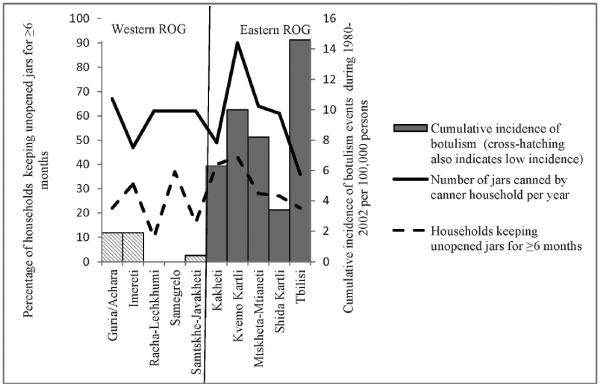
Description:Foodborne botulism is a severe, paralytic illness caused by ingestion of preformed neurotoxins produced by Clostridium botulinum. In 2003, we conducted a population-based household survey of home canning practices to explore marked regional variations in botulism incidence in the Republic of Georgia (ROG). We designed a cluster sampling scheme and subdivided each of the 10 regions of the ROG into a variable number of strata. Households were selected from each stratum using a two-step cluster sampling methodology. We administered a questionnaire about home canning practices to household members responsible for food preparation. Using multivariate logistic regression analysis, we modeled high (eastern ROG) against low (western ROG) incidence areas. Overall, we surveyed 2,742 households nationwide. Home canning with a capping device hermetically sealing the lid covering the jar was practiced by 1,909 households (65.9%; 95% confidence interval [CI]: 59.8 to 72.1%). Canning was more prevalent in regions of low botulism incidence (34 versus 32%; P < 0.01). When compared with low-botulism areas, the following practices were associated with an increased risk in high-botulism areas: ≥ 6 months between canning vegetables and consuming them (adjusted odds ratio [aOR] = 2.1; 95% CI: 1.3 to 3.5) and adding any of the following ingredients to the jar at time of preparation: >1 tablespoon of salt per liter (aOR = 5.1; 95% CI: 1.2 to 22.6); vinegar (aOR = 2.2; 95% CI: 1.3 to 3.7), and greens (aOR = 5.6; 95% CI: 1.7 to 18.2). The following practices were associated with a decreased risk in high-botulism areas: >57 jars canned per household annually (aOR = 0.5; 95% CI: 0.3 to 0.9), covering or immersing vegetables in boiling water before placing them into the jar (aOR = 0.3 95% CI: 0.2 to 0.6), covering or immersing vegetables in boiling water after placing them into the jar (aOR = 0.4; 95% CI: 0.2 to 0.9), or adding garlic (aOR = 0.2; 95% CI: 0.1 to 0.5) or aspirin (aOR = 0.1; 95% CI: 0.1 to 0.2) to the jar at the time of preparation.
-
Subjects:
-
Source:J Food Prot. 78(4):746-750
-
Pubmed ID:25836400
-
Pubmed Central ID:PMC4663683
-
Document Type:
-
Funding:
-
Volume:78
-
Issue:4
-
Collection(s):
-
Main Document Checksum:urn:sha256:cd57587213e8aa1ac2ce506e29694d82937d26178407cbc10d0928916b5c0a64
-
Download URL:
-
File Type:
 [PDF
- 407.21 KB
]
[PDF
- 407.21 KB
]
Supporting Files


File Language:
English
ON THIS PAGE


CDC STACKS serves as an archival repository of CDC-published products including
scientific findings,
journal articles, guidelines, recommendations, or other public health information authored or
co-authored by CDC or funded partners.
As a repository, CDC STACKS retains documents in their original published format to ensure public access to scientific information.
As a repository, CDC STACKS retains documents in their original published format to ensure public access to scientific information.
You May Also Like
COLLECTION
CDC Public Access