


Regional Differences in Sugar-Sweetened Beverage Intake among US Adults
Supporting Files

-
Jul 29 2015
File Language:
English
Details
-
Alternative Title:J Acad Nutr Diet
-
Personal Author:
-
Description:Background
Higher consumption of sugar-sweetened beverages (SSBs) is associated with obesity and type 2 diabetes, and the prevalence of obesity varies by geographic region. Although information on whether SSB intake differs geographically could be valuable for designing targeted interventions, this information is limited.
Objective
This cross-sectional study examined associations between living in specific census regions and frequency of SSB consumption among US adults using 2010 National Health Interview Survey data (n = 25,431).
Methods
SSB consumption was defined as the consumption of four types of beverages (regular sugar-sweetened carbonated beverages, fruit drinks, sports/energy drinks, and sweetened coffee/tea drinks). The exposure variable was census region of residence (Northeast, Midwest, South, and West). We used multivariable logistic regression to estimate adjusted odds ratios (aORs) and 95% CIs for drinking SSBs after controlling for sociodemographic characteristics.
Results
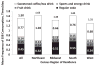
Approximately 64% of adults consumed SSBs ≥1 time/day. The odds of drinking SSBs ≥1 time/day were significantly higher among adults living in the Northeast (aOR = 1.13; 95% CI = 1.01, 1.26) but lower among adults living in the Midwest (aOR = 0.70; 95% CI = 0.64, 0.78) or West (aOR = 0.78; 95% CI = 0.71, 0.87) compared with those living in the South. By type of SSB, the odds of drinking regular soda ≥1 time/day was significantly lower among adults living in the Northeast (aOR = 0.51; 95% CI = 0.45, 0.57), Midwest (aOR = 0.86; 95% CI = 0.78, 0.96), or West (aOR = 0.56; 95% CI = 0.51, 0.62) than those living in the South. The odds of drinking sports/energy drinks ≥1 time/day were significantly lower among adults living in the West (aOR = 0.77; 95% CI = 0.64, 0.93) than those living in the South. The odds of drinking a sweetened coffee/tea drink ≥1 time/day were significantly higher among adults living in the Northeast (aOR = 1.60; 95% CI = 1.43, 1.78) but lower among adults living in the Midwest (aOR = 0.70; 95% CI = 0.62, 0.78) than those living in the South.
Conclusions
Total frequency of SSB consumption and types of SSB consumption differed by geographic region. Interventions to reduce SSB intake could consider regional variations in SSB intake, particularly when more local data are not available.
-
Subjects:
-
Source:J Acad Nutr Diet. 115(12):1996-2002.
-
Pubmed ID:26231057
-
Pubmed Central ID:PMC4663103
-
Document Type:
-
Funding:
-
Place as Subject:
-
Volume:115
-
Issue:12
-
Collection(s):
-
Main Document Checksum:urn:sha256:8596d604ce570e7d44ac074b57ca178df6877bbeed2760b3586968f6f4b1118e
-
Download URL:
-
File Type:
 [PDF
- 351.20 KB
]
[PDF
- 351.20 KB
]
Supporting Files


File Language:
English
ON THIS PAGE


CDC STACKS serves as an archival repository of CDC-published products including
scientific findings,
journal articles, guidelines, recommendations, or other public health information authored or
co-authored by CDC or funded partners.
As a repository, CDC STACKS retains documents in their original published format to ensure public access to scientific information.
As a repository, CDC STACKS retains documents in their original published format to ensure public access to scientific information.
You May Also Like
COLLECTION
CDC Public Access