


Translational Biomarkers of Neurotoxicity: A Health and Environmental Sciences Institute Perspective on the Way Forward
Supporting Files
Public Domain

-
2015/12/01
-
File Language:
English
Details
-
Journal Article:Toxicological Sciences
-
Personal Author:Roberts, Ruth A. ; Aschner, Michael ; Calligaro, David ; Guilarte, Tomas R. ; Hanig, Joseph P. ; Herr, David W. ; Hudzik, Thomas J. ; Jeromin, Andreas ; Kallman, Mary J. ; Liachenko, Serguei ; Lynch, James J. III ; Miller, Diane B. ; Moser, Virginia C. ; O'Callaghan, James P. ; Slikker, William Jr. ; Paule, Merle G.
-
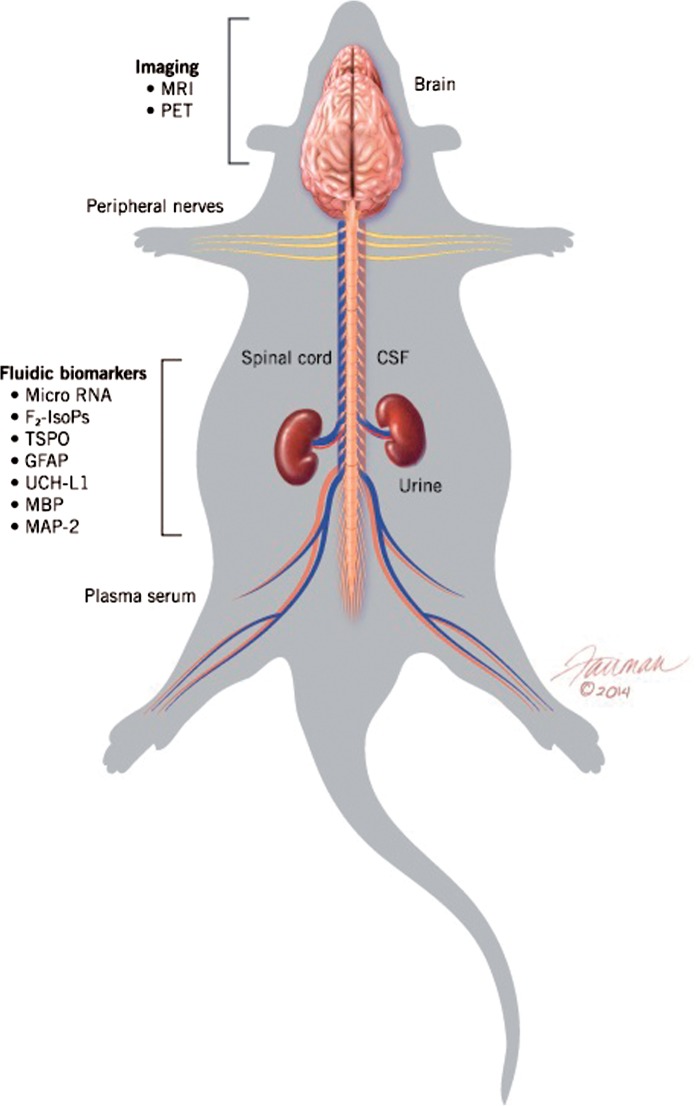
Description:Neurotoxicity has been linked to a number of common drugs and chemicals, yet efficient and accurate methods to detect it are lacking. There is a need for more sensitive and specific biomarkers of neurotoxicity that can help diagnose and predict neurotoxicity that are relevant across animal models and translational from nonclinical to clinical data. Fluid-based biomarkers such as those found in serum, plasma, urine, and cerebrospinal fluid (CSF) have great potential due to the relative ease of sampling compared with tissues. Increasing evidence supports the potential utility of fluid-based biomarkers of neurotoxicity such as microRNAs, F2-isoprostanes, translocator protein, glial fibrillary acidic protein, ubiquitin C-terminal hydrolase L1, myelin basic protein, microtubule-associated protein-2, and total tau. However, some of these biomarkers such as those in CSF require invasive sampling or are specific to one disease such as Alzheimer's, while others require further validation. Additionally, neuroimaging methodologies, including magnetic resonance imaging, magnetic resonance spectroscopy, and positron emission tomography, may also serve as potential biomarkers and have several advantages including being minimally invasive. The development of biomarkers of neurotoxicity is a goal shared by scientists across academia, government, and industry and is an ideal topic to be addressed via the Health and Environmental Sciences Institute (HESI) framework which provides a forum to collaborate on key challenging scientific topics. Here we utilize the HESI framework to propose a consensus on the relative potential of currently described biomarkers of neurotoxicity to assess utility of the selected biomarkers using a nonclinical model. [Description provided by NIOSH]
-
Subjects:
-
Keywords:
-
Source:Toxicol Sci 2015 Dec; 148(2):332-340
-
ISSN:1096-6080
-
Pubmed ID:26609132
-
Pubmed Central ID:PMC4659531
-
Document Type:
-
Genre:
-
Place as Subject:
-
CIO:
-
Division:
-
Topic:
-
Location:
-
Pages in Document:9 pdf pages
-
Volume:148
-
Issue:2
-
NIOSHTIC Number:nn:20047112
-
Contact Point Address:Ruth A. Roberts, ApconiX, BioHub at Alderley Park, Cheshire SK10 4TG, UK
-
Email:ruth.roberts@apconix.com
-
Federal Fiscal Year:2016
-
NORA Priority Area:
-
Peer Reviewed:True
-
Collection(s):
-
Main Document Checksum:urn:sha-512:e8ac4347766f3e3e76e299f811ca59019097813e530bc232a8603c17808b534707747e3413b4ecb81d582cc4fceb6f2d744814dcca3e6bfb5751655465791cbc
-
Download URL:
-
File Type:
 [PDF
- 308.34 KB
]
[PDF
- 308.34 KB
]
Supporting Files


File Language:
English
ON THIS PAGE


CDC STACKS serves as an archival repository of CDC-published products including
scientific findings,
journal articles, guidelines, recommendations, or other public health information authored or
co-authored by CDC or funded partners.
As a repository, CDC STACKS retains documents in their original published format to ensure public access to scientific information.
As a repository, CDC STACKS retains documents in their original published format to ensure public access to scientific information.
You May Also Like