



Health Promotion Interventions for Low-Income Californians Through Medi-Cal Managed Care Plans, 2012
Supporting Files
Public Domain

-
Nov 12 2015
File Language:
English
Details
-
Journal Article:Preventing Chronic Disease (PCD)
-
Personal Author:
-
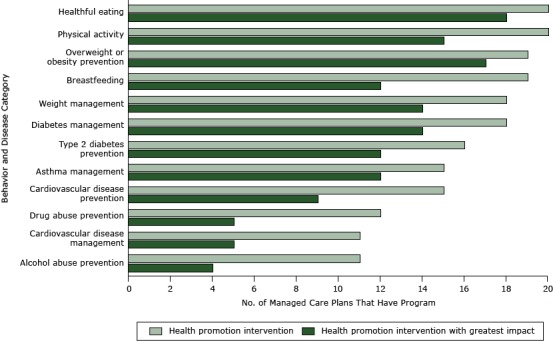
Description:Introduction ; Prevention is the most cost-effective approach to promote population health, yet little is known about the delivery of health promotion interventions in the nation’s largest Medicaid program, Medi-Cal. The purpose of this study was to inventory health promotion interventions delivered through Medi-Cal Managed Care Plans; identify attributes of the interventions that plans judged to have the greatest impact on their members; and determine the extent to which the plans refer members to community assistance programs and sponsor health-promoting community activities. ; Methods ; The lead health educator from each managed care plan was asked to complete a 190-item online survey in January 2013; 20 of 21 managed care plans responded. Survey data on the health promotion interventions with the greatest impact were grouped according to intervention attributes and measures of effectiveness; quantitative data were analyzed using descriptive statistics. ; Results ; Health promotion interventions judged to have the greatest impact on Medi-Cal members were delivered in various ways; educational materials, one-on-one education, and group classes were delivered most frequently. Behavior change, knowledge gain, and improved disease management were cited most often as measures of effectiveness. Across all interventions, median educational hours were limited (2.4 h), and median Medi-Cal member participation was low (265 members per intervention). Most interventions with greatest impact (120 of 137 88%) focused on tertiary prevention. There were mixed results in referring members to community assistance programs and investing in community activities. ; Conclusion ; Managed care plans have many opportunities to more effectively deliver health promotion interventions. Establishing measurable, evidence-based, consensus standards for such programs could facilitate improved delivery of these services.
-
Subjects:
-
Source:Prev Chronic Dis. 12.
-
DOI:
-
ISSN:1545-1151
-
Pubmed ID:26564012
-
Pubmed Central ID:PMC4651139
-
Document Type:
-
Place as Subject:
-
Volume:12
-
Download URL:
-
File Type:
 [PDF - 366.79 KB]
 -
Collection(s):
-
Main Document Checksum:urn:sha-512:476c26d05c9a235ca1cf093b6f2346e792171986bfbdf215f3cbb84470dc4e24594f3cb94fbb4f86649c03ea57e41fac2656f1815ce19a916ff56be5373c2906
Supporting Files


File Language:
English
 Was this page helpful?
 Found an issue?

CDC STACKS serves as an archival repository of CDC-published products including
scientific findings, journal articles, guidelines, recommendations, or other public health information authored or
co-authored by CDC or funded partners.
As a repository, CDC STACKS retains documents in their original published format to ensure public access to scientific information.
As a repository, CDC STACKS retains documents in their original published format to ensure public access to scientific information.
You May Also Like
COLLECTION
Preventing Chronic Disease