


Patient and Community-Level Socio-Demographic Characteristics Associated with Emergency Department Visits for Childhood Injury; A Retrospective Analysis of Data from the Pediatric Emergency Care Applied Research Network (PECARN) Core Data Project 2004–2008
Supporting Files

-
9 2015
-
File Language:
English
Details
-
Alternative Title:J Pediatr
-
Personal Author:
-
Description:Objective
To examine pediatric emergency department (ED) visits over 5 years, trends in injury severity, and associations between injury-related ED visit outcome and patient and community-level socio-demographic characteristics.
Study design
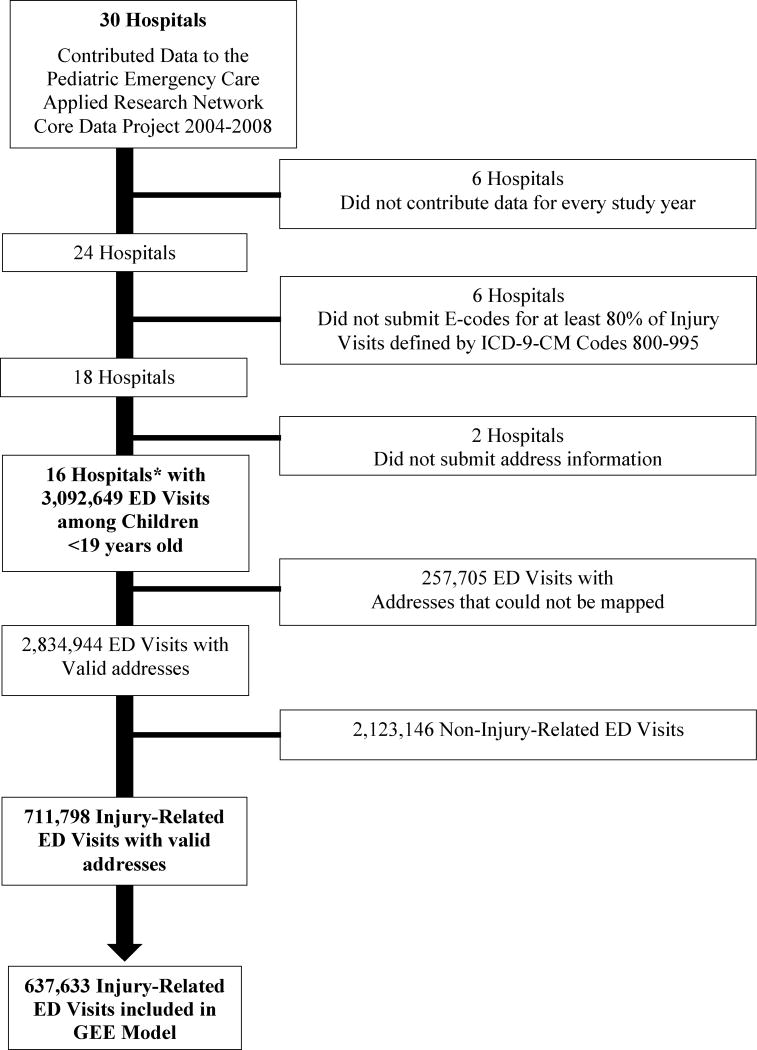
Retrospective analysis of administrative data provided to the Pediatric Emergency Care Applied Research Network Core Data Project, 2004–2008. Home addresses were geocoded to determine census block group and associated socio-demographic characteristics. Maximum Abbreviated Injury Scale severity and Severity Classification System scores were calculated. Generalized estimating equations were used to test for associations between socio-demographic characteristics and admission or transfer among injury-related ED visits.
Results
Overall ED visits and injury-related visits increased from 2004 to 2008 at study sites. Of 2,833,676 successfully geocoded visits, 700,821 (24.7%) were injury-related. The proportion of higher severity injury-related visits remained consistent. Nearly 10% of injury-related visits resulted in admission or transfer each year. After adjusting for age, sex, payer, and injury severity, odds of admission or transfer were lower among minority children and children from areas with moderate and high prevalence of poverty.
Conclusions
Pediatric injury-related ED visits to included sites increased over the study period while injury severity, anticipated resource utilization, and visit outcomes remained stable, with low rates of admission or transfer. Socio-demographic differences in injury-related visits and ED disposition were apparent. ED-based injury surveillance is essential to understand disparities, inform targets for prevention programs, and reduce the overall burden of childhood injuries.
-
Subjects:
-
Keywords:
-
Source:J Pediatr. 167(3):711-718.e4
-
Pubmed ID:26141551
-
Pubmed Central ID:PMC4554798
-
Document Type:
-
Funding:U03MC00006/PHS HHSUnited States/ ; U03MC22685/PHS HHSUnited States/ ; R49CE002099/CE/NCIPC CDC HHSUnited States/ ; 5K08HD073241-02/HD/NICHD NIH HHSUnited States/ ; U03MC00008/PHS HHSUnited States/ ; K08 HD073241/HD/NICHD NIH HHSUnited States/ ; U03MC00007/PHS HHSUnited States/ ; R49CE002099/ACL/ACL HHSUnited States/ ; U03MC00003/PHS HHSUnited States/ ; U01 CE002698/CE/NCIPC CDC HHSUnited States/ ; U03MC22684/PHS HHSUnited States/ ; U03MC00001/PHS HHSUnited States/ ; K23 HD070913/HD/NICHD NIH HHSUnited States/
-
Volume:167
-
Issue:3
-
Collection(s):
-
Main Document Checksum:urn:sha-512:684f03171de7bc55246a5ac5e5fb5da41ae3bc148e59053525e074672ef87cd1ca66a3e73305d94bb3c9e7be2988b67672a68c4b45745cb6e25ebbfa391aac01
-
Download URL:
-
File Type:
 [PDF
- 636.59 KB
]
[PDF
- 636.59 KB
]
Supporting Files


File Language:
English
ON THIS PAGE


CDC STACKS serves as an archival repository of CDC-published products including
scientific findings,
journal articles, guidelines, recommendations, or other public health information authored or
co-authored by CDC or funded partners.
As a repository, CDC STACKS retains documents in their original published format to ensure public access to scientific information.
As a repository, CDC STACKS retains documents in their original published format to ensure public access to scientific information.
You May Also Like
COLLECTION
CDC Public Access