


U.S. census unit population exposures to ambient air pollutants
Supporting Files
Public Domain

-
Jan 12 2012
-
File Language:
English
Details
-
Alternative Title:Int J Health Geogr
-
Personal Author:
-
Description:Background
Progress has been made recently in estimating ambient PM2.5 (particulate matter with aerodynamic diameter < 2.5 μm) and ozone concentrations using various data sources and advanced modeling techniques, which resulted in gridded surfaces. However, epidemiologic and health impact studies often require population exposures to ambient air pollutants to be presented at an appropriate census geographic unit (CGU), where health data are usually available to maintain confidentiality of individual health data. We aim to generate estimates of population exposures to ambient PM2.5 and ozone for U.S. CGUs.
Methods
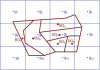
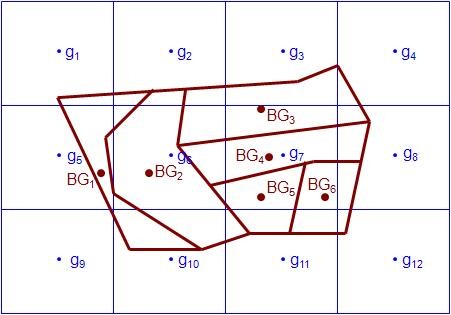
We converted 2001-2006 gridded data, generated by the U.S. Environmental Protection Agency (EPA) for CDC's (Centers for Disease Control and Prevention) Environmental Public Health Tracking Network (EPHTN), to census block group (BG) based on spatial proximities between BG and its four nearest grids. We used a bottom-up (fine to coarse) strategy to generate population exposure estimates for larger CGUs by aggregating BG estimates weighted by population distribution.
Results
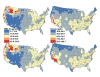
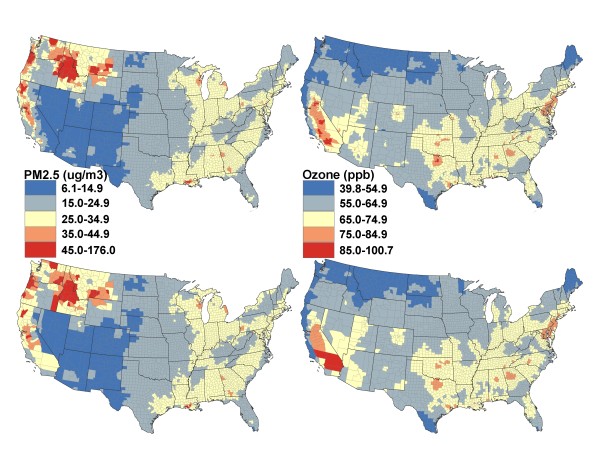
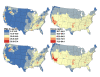
The BG daily estimates were comparable to monitoring data. On average, the estimates deviated by 2 μg/m3 (for PM2.5) and 3 ppb (for ozone) from their corresponding observed values. Population exposures to ambient PM2.5 and ozone varied greatly across the U.S. In 2006, estimates for daily potential population exposure to ambient PM2.5 in west coast states, the northwest and a few areas in the east and estimates for daily potential population exposure to ambient ozone in most of California and a few areas in the east/southeast exceeded the National Ambient Air Quality Standards (NAAQS) for at least 7 days.
Conclusions
These estimates may be useful in assessing health impacts through linkage studies and in communicating with the public and policy makers for potential intervention.
-
Subjects:
-
Source:Int J Health Geogr. 2012; 11:3.
-
Document Type:
-
Place as Subject:
-
Volume:11
-
Collection(s):
-
Main Document Checksum:urn:sha-512:94a71506f9b5da1c5b1bf559171479208db80df9270eb14e80bbe066c0dd406eeaa085c67a97c9b799d01a9a01e7998c22ee4e51da3a7147437e575c29d2754f
-
Download URL:
-
File Type:
 [PDF
- 4.63 MB
]
[PDF
- 4.63 MB
]
Supporting Files


File Language:
English
ON THIS PAGE


CDC STACKS serves as an archival repository of CDC-published products including
scientific findings,
journal articles, guidelines, recommendations, or other public health information authored or
co-authored by CDC or funded partners.
As a repository, CDC STACKS retains documents in their original published format to ensure public access to scientific information.
As a repository, CDC STACKS retains documents in their original published format to ensure public access to scientific information.
You May Also Like
COLLECTION
CDC Public Access