


Menstrual function among women exposed to polybrominated biphenyls: A follow-up prevalence study
Supporting Files

-
Aug 09 2005
-
File Language:
English
Details
-
Alternative Title:Environ Health
-
Personal Author:
-
Description:Background
Alteration in menstrual cycle function is suggested among rhesus monkeys and humans exposed to polybrominated biphenyls (PBBs) and structurally similar polychlorinated biphenyls (PCBs). The feedback system for menstrual cycle function potentially allows multiple pathways for disruption directly through the hypothalamic-pituitary-ovarian axis and indirectly through alternative neuroendocrine axes.
Methods
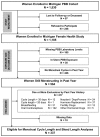
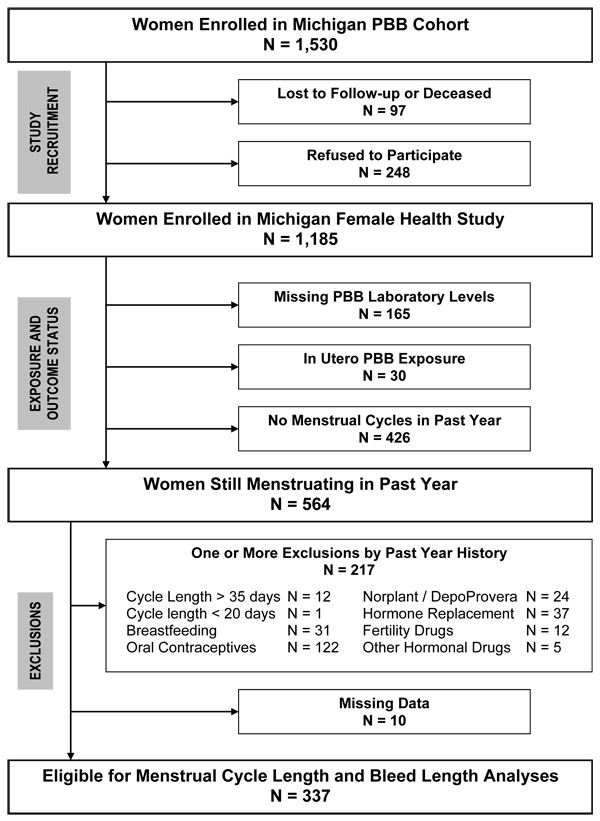
The Michigan Female Health Study was conducted during 1997–1998 among women in a cohort exposed to PBBs in 1973. This study included 337 women with self-reported menstrual cycles of 20–35 days (age range: 24–56 years). Current PBB levels were estimated by exponential decay modeling of serum PBB levels collected from 1976–1987 during enrollment in the Michigan PBB cohort. Linear regression models for menstrual cycle length and the logarithm of bleed length used estimated current PBB exposure or enrollment PBB exposure categorized in tertiles, and for the upper decile. All models were adjusted for serum PCB levels, age, body mass index, history of at least 10% weight loss in the past year, physical activity, smoking, education, and household income.
Results
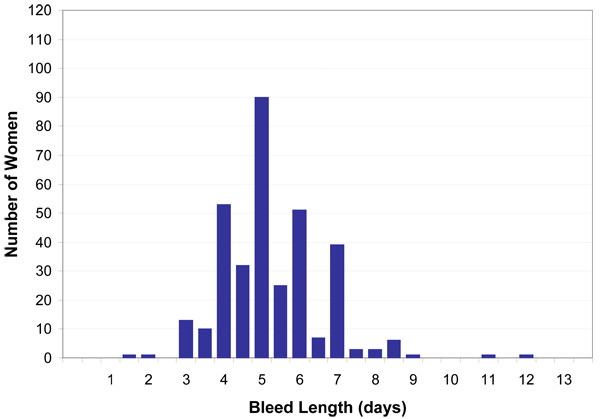
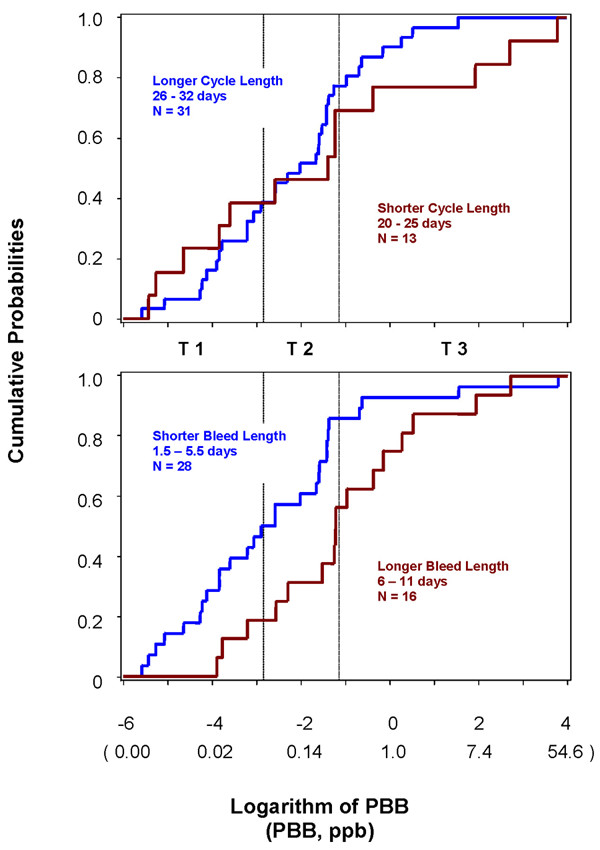
Higher levels of physical activity were associated with shorter bleed length, and increasing age was associated with shorter cycle length. Although no overall association was found between PBB exposure and menstrual cycle characteristics, a significant interaction between PBB exposures with past year weight loss was found. Longer bleed length and shorter cycle length were associated with higher PBB exposure among women with past year weight loss.
Conclusion
This study suggests that PBB exposure may impact ovarian function as indicated by menstrual cycle length and bleed length. However, these associations were found among the small number of women with recent weight loss suggesting either a chance finding or that mobilization of PBBs from lipid stores may be important. These results should be replicated with larger numbers of women exposed to similar lipophilic compounds.
-
Subjects:
-
Source:Environ Health. 2005; 4:15.
-
Document Type:
-
Funding:
-
Place as Subject:
-
Volume:4
-
Collection(s):
-
Main Document Checksum:urn:sha-512:ac92cf79f996bc2a608086e22a08b552be6018fc75ef6c8a218e344eb769562eb50448e7b325f6ada3138579992188cdc8be170f816cdc8aeef725347b4f3992
-
Download URL:
-
File Type:
 [PDF
- 571.15 KB
]
[PDF
- 571.15 KB
]
Supporting Files


File Language:
English
ON THIS PAGE



CDC STACKS serves as an archival repository of CDC-published products including
scientific findings,
journal articles, guidelines, recommendations, or other public health information authored or
co-authored by CDC or funded partners.
As a repository, CDC STACKS retains documents in their original published format to ensure public access to scientific information.
As a repository, CDC STACKS retains documents in their original published format to ensure public access to scientific information.
You May Also Like
COLLECTION
CDC Public Access