



Hepatitis C Virus Screening and Management of Seroconversions in Hemodialysis Facilities
Supporting Files

-
2013/01/01
-
Available in CDC Stacks on 2015-10-26T00:00:00Z
File Language:
English
Details
-
Alternative Title:Semin Dial
-
Personal Author:
-
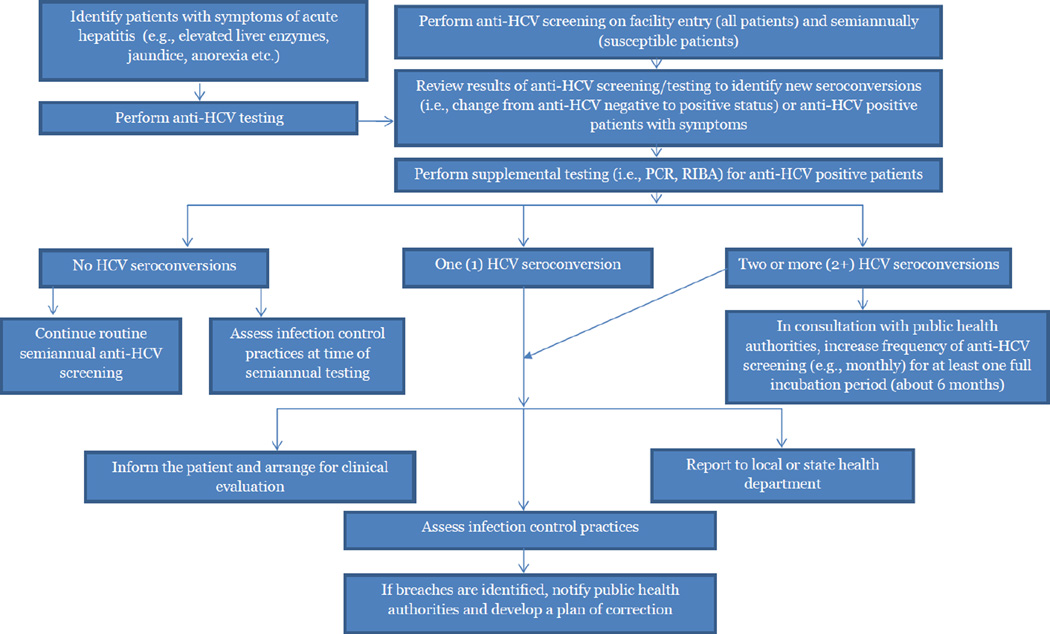
Description:Over the past two decades, healthcare-associated exposure has increasingly been proved to be a means of hepatitis C virus (HCV) transmission, especially in hemodialysis facilities. The prevalence of HCV among hemodialysis patients is known to be several times greater than that of the general population of the United States, and chronic HCV infection is associated with significant morbidity and mortality among these patients. During 2008-2011, HCV infection outbreaks were identified in multiple US hemodialysis facilities, resulting in at least 46 new HCV infections among hemodialysis patients. These outbreaks, linked to infection control breaches, also highlight the failure of some facilities to follow established guidelines for routine HCV antibody (anti-HCV) screening and response to new HCV infection among hemodialysis patients. Current national guidelines recommend screening of hemodialysis patients for anti-HCV on facility admission and, for susceptible patients, on a semiannual basis. Here, we seek to underscore the importance of compliance with national recommendations for anti-HCV screening of hemodialysis patients and actions to be taken in the event of possible HCV transmission within a hemodialysis facility. These include general steps to ensure that: hemodialysis patients are routinely screened for anti-HCV to facilitate early detection of new infections; newly infected patients are informed of the change in their HCV status and undergo clinical evaluation; and public health officials are notified of new HCV infections in a timely manner. We then focus on the need to assess infection control practices at the facility, with particular attention given to safe handling of injectable medications, hand hygiene and disinfection practices. In the absence of a vaccine, routine screening and adherence to standard infection control practices will remain the key strategies for preventing HCV transmission in hemodialysis units.
-
Subjects:
- Ambulatory Care Facilities
- Communicable Disease Control
- Cross Infection
- Disease Outbreaks
- Disease Transmission, Infectious
- Female
- Hemodialysis Units, Hospital
- Hepacivirus
- Hepatitis C
- Humans
- Kidney Failure, Chronic
- Male
- Mass Screening
- Practice Guidelines as Topic
- Prevalence
- Renal Dialysis
- Risk Assessment
- Survival Analysis
-
Keywords:
-
Source:Semin Dial. 26(4):439-446
-
Pubmed ID:23859188
-
Pubmed Central ID:PMC4620197
-
Document Type:
-
Funding:
-
Genre:
-
Volume:26
-
Issue:4
-
Download URL:
-
File Type:
 [PDF - 635.33 KB]
 -
Collection(s):
-
Main Document Checksum:urn:sha-512:0bcf7de06bf04506a6ae2c1a5f7c8a503ad993a9ea9423e32da9d2f3645528262be4e58d82dc0e61c80b18f5cc68a5e4f4959e3c998b18eedb6690d4c0e23033
Supporting Files


File Language:
English
 Was this page helpful?
 Found an issue?




CDC STACKS serves as an archival repository of CDC-published products including
scientific findings, journal articles, guidelines, recommendations, or other public health information authored or
co-authored by CDC or funded partners.
As a repository, CDC STACKS retains documents in their original published format to ensure public access to scientific information.
As a repository, CDC STACKS retains documents in their original published format to ensure public access to scientific information.
You May Also Like
COLLECTION
CDC Public Access