



Hospitalizations and Associated Costs in a Population-Based Study of Children with Down Syndrome Born in Florida
Supporting Files

-
11 2014 ; 11-2014
-
Available in CDC Stacks on November 01, 2015, 12:00 AM
File Language:
English
Details
-
Alternative Title:Birth Defects Res A Clin Mol Teratol
-
Personal Author:
-
Description:Background
Our objective was to examine differences in hospital resource utilization for children with Down syndrome by age and the presence of other birth defects, particularly severe and non-severe congenital heart defects (CHDs).
Methods
This was a retrospective, population-based, statewide study of children with Down syndrome born 1998-2007, identified by the Florida Birth Defects Registry (FBDR) and linked to hospital discharge records for 1-10 years after birth. To evaluate hospital resource utilization, descriptive statistics on number of hospitalized days and hospital costs were calculated. Results were stratified by isolated Down syndrome (no other coded major birth defect); presence of severe and non-severe CHDs; and presence of major FBDR-eligible birth defects without CHDs.
Results
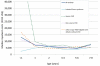
For 2,552 children with Down syndrome, there were 6,856 inpatient admissions, of which 68.9% occurred during the first year of life (infancy). Of the 2,552 children, 31.7% (n=808) had isolated Down syndrome, 24.0% (n=612) had severe CHDs, 36.3% (n=927) had non-severe CHDs, and 8.0% (n=205) had a major FBDR-eligible birth defect in the absence of CHD. Infants in all three non-isolated DS groups had significantly higher hospital costs compared to those with isolated Down syndrome. From infancy through age 4, children with severe CHDs had the highest inpatient costs compared to children in the other sub-groups.
Conclusions
Results support findings that for children with Down syndrome the presence of other anomalies influences hospital use and costs, and children with severe CHDs have greater hospital resource utilization than children with other CHDs or major birth defects without CHDs. -
Subjects:
-
Keywords:
-
Source:Birth Defects Res A Clin Mol Teratol. 100(11):826-836
-
Pubmed ID:25124730
-
Pubmed Central ID:PMC4617639
-
Document Type:
-
Funding:
-
Volume:100
-
Issue:11
-
Download URL:
-
File Type:
 [PDF - 460.21 KB]
 -
Collection(s):
-
Main Document Checksum:urn:sha256:82536cdbeb0d3a3f92a12c2fa3a1c1e8541beca6b616aa9e7d66774f71ac371b
Supporting Files


File Language:
English
 Was this page helpful?
 Found an issue?


CDC STACKS serves as an archival repository of CDC-published products including
scientific findings, journal articles, guidelines, recommendations, or other public health information authored or
co-authored by CDC or funded partners.
As a repository, CDC STACKS retains documents in their original published format to ensure public access to scientific information.
As a repository, CDC STACKS retains documents in their original published format to ensure public access to scientific information.
You May Also Like
COLLECTION
CDC Public Access