


Haemophilus influenzae Type b Disease and Vaccine Booster Dose Deferral, United States, 1998–2009
Supporting Files

-
Aug 06 2012
-
File Language:
English
Details
-
Alternative Title:Pediatrics
-
Personal Author:
-
Description:BACKGROUND
Since the introduction of effective vaccines, the incidence of invasive Haemophilus influenzae type b (Hib) disease among children <5 years of age has decreased by 99% in the United States. In response to a limited vaccine supply that began in 2007, Hib booster doses were deferred for 18 months.
METHODS
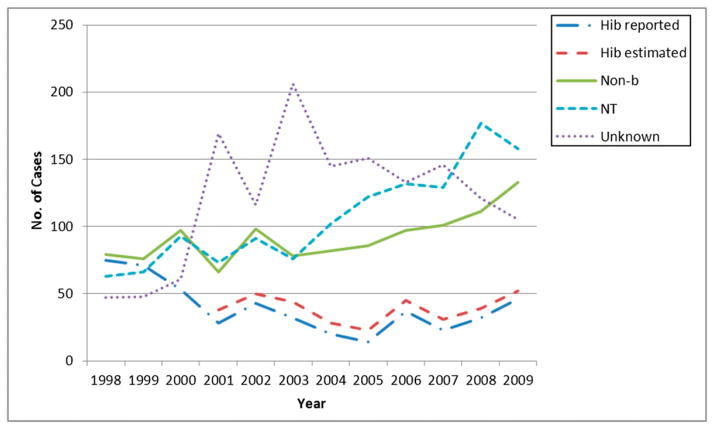
We reviewed national passive and active surveillance (demographic and serotype) and vaccination status data for invasive H. influenzae disease in children aged <5 years before (1998–2007) and during (2008–2009) the vaccine shortage years to assess the impact of the vaccine deferral on Hib disease. We estimated the average annual number of Hib cases misclassified as unknown (not completed or missing) serotype.
RESULTS
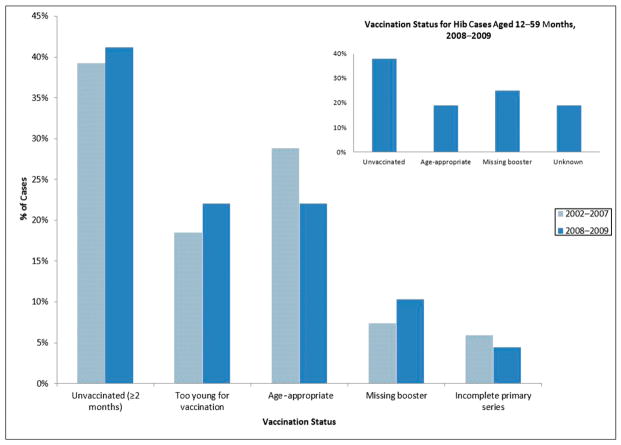
From 1998 to 2007 and 2008 to 2009, the annual average incidence of Hib disease per 100 000 population was 0.2 and 0.18, respectively; no significant difference in incidence was found by age group, gender, or race. Among Hib cases in both time periods, most were unvaccinated or too young to have received Hib vaccine. During 2001 to 2009, there were <53 Hib cases per year, with an estimated 6 to 12 Hib cases misclassified as unknown serotype.
CONCLUSIONS
The booster deferral did not have a significant impact on the burden of invasive Hib disease in children <5 years of age. Continued surveillance and serotype data are important to monitor changes in Hib incidence, especially during vaccine deferrals. Hib booster deferral is a reasonable short-term approach to a Hib vaccine shortage.
-
Subjects:
-
Source:Pediatrics. 130(3):414-420.
-
Pubmed ID:22869828
-
Pubmed Central ID:PMC4603375
-
Document Type:
-
Funding:
-
Place as Subject:
-
Volume:130
-
Issue:3
-
Collection(s):
-
Main Document Checksum:urn:sha256:3579004fc5311ee35fd91fd6fa06b30cb1e8ba26c52f5c545a069fd49348c6ff
-
Download URL:
-
File Type:
 [PDF
- 319.97 KB
]
[PDF
- 319.97 KB
]
Supporting Files


File Language:
English
ON THIS PAGE


CDC STACKS serves as an archival repository of CDC-published products including
scientific findings,
journal articles, guidelines, recommendations, or other public health information authored or
co-authored by CDC or funded partners.
As a repository, CDC STACKS retains documents in their original published format to ensure public access to scientific information.
As a repository, CDC STACKS retains documents in their original published format to ensure public access to scientific information.
You May Also Like
COLLECTION
CDC Public Access