


Disparate distribution of hepatitis B virus genotypes in four sub-Saharan African countries
Supporting Files

-
9-2013
-
File Language:
English
Details
-
Alternative Title:J Clin Virol
-
Personal Author:
-
Description:Background
Hepatitis B virus (HBV) places a substantial health burden on Africa. Here, we investigated genetic diversity of HBV variants circulating in 4 countries of sub-Saharan Africa using archived samples. In total, 1492 plasma samples were tested from HIV-infected individuals and pregnant women, among which 143 (9.6%) were PCR-positive for HBV DNA (Côte d’Ivoire, 70/608 [11.5%]; Ghana, 13/444 [2.9%]; Cameroon, 33/303 [10.9%]; and Uganda, 27/137 [19.7%]).
Study design/results
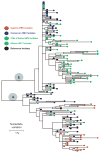
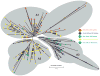
Phylogenetic analysis of the S-gene sequences identified HBV genotypes E (HBV/E, n = 96) and A (HBV/A, n = 47) distributed as follows: 87% of HBV/E and 13% of HBV/A in Côte d’Ivoire; 100% of HBV/E in Ghana; 67% of HBV/E and 33% of HBV/A in Cameroon; and 100% of HBV/A in Uganda. The average and maximal nucleotide distances among HBV/E sequences were 1.9% and 6.4%, respectively, suggesting a greater genetic diversity for this genotype than previously reported (p < 0.001). HBV/A strains were classified into subgenotypes HBV/A1, HBV/A2 and HBV/A3. In Uganda, 93% of HBV/A strains belonged to HBV/A1 whereas HBV/A3 was the only subgenotype of HBV/A found in Cameroon. In Côte d’Ivoire, HBV/A strains were classified as HBV/A1 (11.1%), HBV/A2 (33.3%) and HBV/A3 (55.6%). Phylogeographic analysis of the sequences available from Africa supported earlier suggestions on the origin of HBV/A1, HBV/A2 and HBV/A3 in East, South and West/Central Africa, respectively. Using predicted amino acid sequences, hepatitis B surface antigen (HBsAg) was classified into serotype ayw4 in 93% of HBV/E strains and adw2 in 68% of HBV/A strains. Also, 7.7% of the sequences carried substitutions in HBsAg associated with immune escape.
Conclusions
The observations of pan-African and global dissemination of HBV/A1 and HBV/A2, and the circulation of HBV/E and HBV/A3 almost exclusively in West and Central Africa suggest a more recent increase in prevalence in Africa of HBV/E and HBV/A3 compared to HBV/A1 and HBV/A2. The broad genetic heterogeneity of HBsAg detected here may impact the efficacy of prevention and control efforts in sub-Saharan Africa.
-
Subjects:
-
Source:J Clin Virol. 58(1):59-66
-
Pubmed ID:23871163
-
Pubmed Central ID:PMC4591023
-
Document Type:
-
Funding:
-
Place as Subject:
-
Volume:58
-
Issue:1
-
Collection(s):
-
Main Document Checksum:urn:sha256:02446a919ca6c4ef860cfae10a11d7a23185f2036a63736ee32e6b0df7b44164
-
Download URL:
-
File Type:
 [PDF
- 677.24 KB
]
[PDF
- 677.24 KB
]
Supporting Files


File Language:
English
ON THIS PAGE




CDC STACKS serves as an archival repository of CDC-published products including
scientific findings,
journal articles, guidelines, recommendations, or other public health information authored or
co-authored by CDC or funded partners.
As a repository, CDC STACKS retains documents in their original published format to ensure public access to scientific information.
As a repository, CDC STACKS retains documents in their original published format to ensure public access to scientific information.
You May Also Like
COLLECTION
CDC Public Access