


Intra-host Diversity and Evolution of Hepatitis C Virus Endemic to Côte D’Ivoire
Supporting Files

-
5 2014
-
File Language:
English
Details
-
Alternative Title:J Med Virol
-
Personal Author:
-
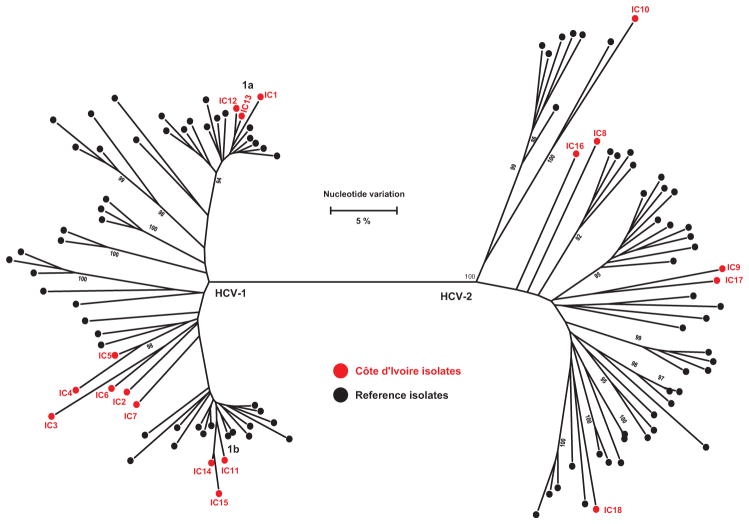
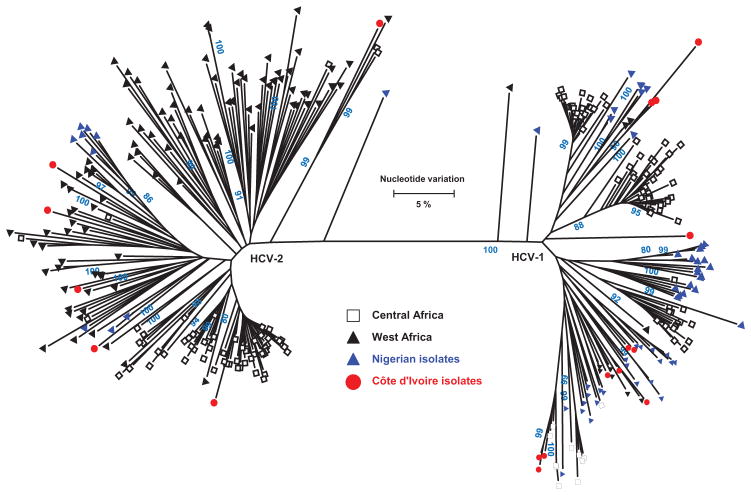
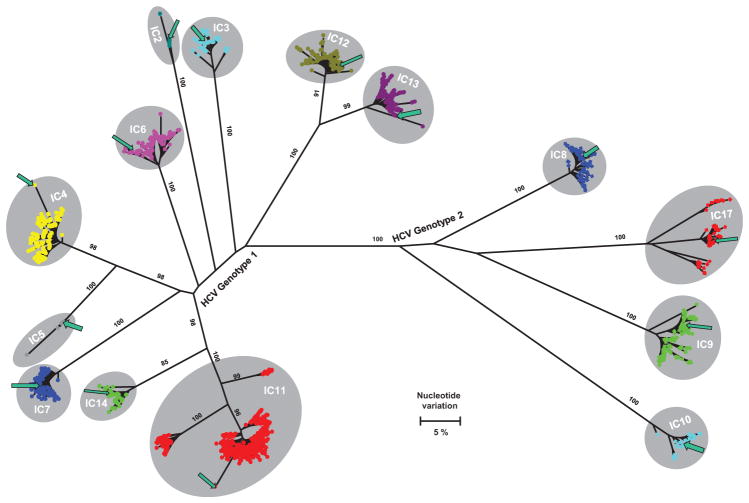
Description:Hepatitis C virus (HCV) infection presents an important, but underappreciated public health problem in Africa. In Côte d'Ivoire, very little is known about the molecular dynamics of HCV infection. Plasma samples (n = 608) from pregnant women collected in 1995 from Côte d'Ivoire were analyzed in this study. Only 18 specimens (∼3%) were found to be HCV PCR-positive. Phylogenetic analysis of the HCV NS5b sequences showed that the HCV variants belong to genotype 1 (HCV1) (n = 12, 67%) and genotype 2 (HCV2) (n = 6, 33%), with a maximum genetic diversity among HCV variants in each genotype being 20.7% and 24.0%, respectively. Although all HCV2 variants were genetically distant from each other, six HCV1 variants formed two tight sub-clusters belonging to HCV1a and HCV1b. Analysis of molecular variance (AMOVA) showed that the genetic structure of HCV isolates from West Africa with Côte d'Ivoire included were significantly different from Central African strains (P = 0.0001). Examination of intra-host viral populations using next-generation sequencing of the HCV HVR1 showed a significant variation in intra-host genetic diversity among infected individuals, with some strains composed of sub-populations as distant from each other as viral populations from different hosts. Collectively, the results indicate a complex HCV evolution in Côte d'Ivoire, similar to the rest of West Africa, and suggest a unique HCV epidemic history in the country.
-
Subjects:
-
Source:J Med Virol. 86(5):765-771
-
Pubmed ID:24519518
-
Pubmed Central ID:PMC4591020
-
Document Type:
-
Funding:
-
Volume:86
-
Issue:5
-
Collection(s):
-
Main Document Checksum:urn:sha256:9e9303798f0408cc2dab3698d82186edc7ea801b9024b5d9c1d6ce3b721f1613
-
Download URL:
-
File Type:
 [PDF
- 462.37 KB
]
[PDF
- 462.37 KB
]
Supporting Files


File Language:
English
ON THIS PAGE


CDC STACKS serves as an archival repository of CDC-published products including
scientific findings,
journal articles, guidelines, recommendations, or other public health information authored or
co-authored by CDC or funded partners.
As a repository, CDC STACKS retains documents in their original published format to ensure public access to scientific information.
As a repository, CDC STACKS retains documents in their original published format to ensure public access to scientific information.
You May Also Like
COLLECTION
CDC Public Access