


Racial/Ethnic Differences in Obesity Trends Among Young Low-Income Children
Supporting Files

-
5 2015
-
File Language:
English
Details
-
Alternative Title:Am J Prev Med
-
Personal Author:
-
Description:Introduction
Racial/ethnic differences in recent obesity trends have not been reported among young low-income children. The purpose of this study is to examine trends in obesity prevalence from 1998 through 2011 by race/ethnicity among low-income children aged 2–4 years.
Methods
The study was based on measured weight and height records of 29,040,851 participants of federally funded health and nutrition programs from 30 states and the District of Columbia, which provided data each year from 1998 through 2011. More than 80% of data were collected through the Special Supplemental Nutrition Program for Women, Infants, and Children, and about 50% of eligible children were included. In 2014, joinpoint regression was used to identify the inflection years when significant changes in obesity trends occurred and piecewise logistic regression was used to examine annual changes in obesity prevalence before and after the inflection years controlling for age, sex, and race/ethnicity.
Results
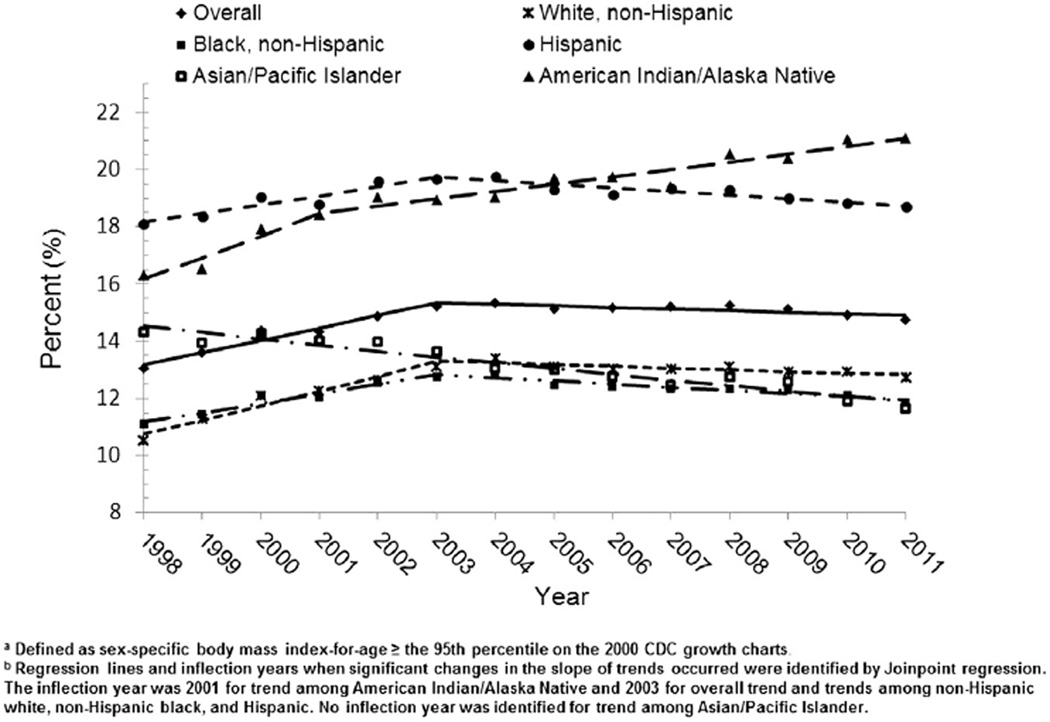
The overall obesity prevalence increased from 13.05% in 1998 to 15.21% in 2003, and decreased slightly to 14.74% in 2011. The increasing trends among non-Hispanic white, non-Hispanic black, and Hispanic children began decreasing in 2003. Asian/Pacific Islander was the only racial/ethnic group with a continual decreasing trend in obesity prevalence from 1998 (14.34%) through 2011 (11.66%). Among American Indian/Alaska Native children, obesity prevalence consistently increased from 16.32% in 1998 to 21.11% in 2011, although the annual increases slowed since 2001.
Conclusions
The study findings indicate modest recent declines in obesity prevalence for most racial/ethnic groups of low-income children aged 2–4 years. However, obesity prevalence remains high.
-
Subjects:
-
Source:Am J Prev Med. 48(5):570-574
-
Pubmed ID:25891056
-
Pubmed Central ID:PMC4582763
-
Document Type:
-
Funding:
-
Volume:48
-
Issue:5
-
Collection(s):
-
Main Document Checksum:urn:sha256:bb51641682887f1d82bd03cbe8a52222a9f72f232fecfb2e3d68cdfa6e93336b
-
Download URL:
-
File Type:
 [PDF
- 567.01 KB
]
[PDF
- 567.01 KB
]
Supporting Files


File Language:
English
ON THIS PAGE

CDC STACKS serves as an archival repository of CDC-published products including
scientific findings,
journal articles, guidelines, recommendations, or other public health information authored or
co-authored by CDC or funded partners.
As a repository, CDC STACKS retains documents in their original published format to ensure public access to scientific information.
As a repository, CDC STACKS retains documents in their original published format to ensure public access to scientific information.
You May Also Like
COLLECTION
CDC Public Access