


Relationship between body mass index and perceived insufficient sleep among U.S. adults: an analysis of 2008 BRFSS data
Supporting Files

-
May 10 2011
-
File Language:
English
Details
-
Alternative Title:BMC Public Health
-
Personal Author:
-
Description:Background
Over the past 50 years, the average sleep duration for adults in the United States has decreased while the prevalence of obesity and associated outcomes has increased. The objective of this study was to determine whether perceived insufficient sleep was associated with body mass index (BMI) in a national sample.
Methods
We analyzed data from the 2008 Behavioral Risk Factor Surveillance System (BRFSS) survey (N = 384,541) in which respondents were asked, "During the past 30 days, for about how many days have you felt you did not get enough rest or sleep?" We divided respondents into six BMI categories and used multivariable linear regression and logistic regression analyses to assess the association between BMI categories and days of insufficient sleep after adjusting for sociodemographic variables, smoking, physical activity, and frequent mental distress.
Results
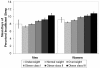
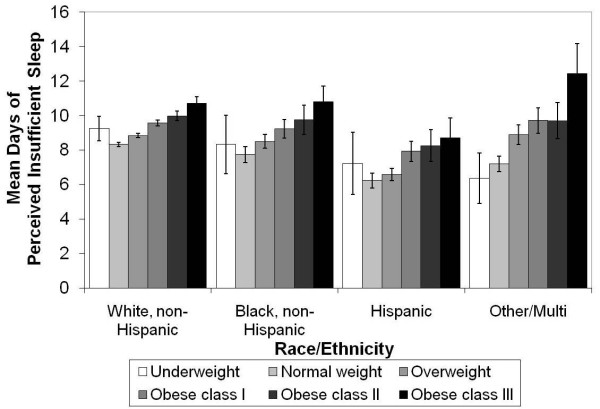
Adjusted mean days of insufficient sleep ranged from 7.9 (95% confidence interval [CI]: 7.8, 8.0) days for people of normal weight to 10.5 (95% CI: 10.2, 10.9) days for those in the highest weight category (BMI ≥ 40). Days of perceived insufficient sleep followed a linear trend across BMI categories. The likelihood of reporting ≥14 days of insufficient sleep in the previous 30 days was higher for respondents in the highest weight category than for those who were normal weight (34.9% vs. 25.2%; adjusted odds ratio = 1.7 (95% CI: 1.5, 1.8]).
Conclusion
Among U.S. adults, days of insufficient rest or sleep strongly correlated with BMI. Sleep sufficiency should be an important consideration in the assessment of the health of overweight and obese people and should be considered by developers of weight-reduction programs.
-
Subjects:
-
Source:BMC Public Health. 2011; 11:295.
-
Pubmed ID:21569264
-
Pubmed Central ID:PMC3098793
-
Document Type:
-
Funding:
-
Place as Subject:
-
Volume:11
-
Collection(s):
-
Main Document Checksum:urn:sha-512:24de918cc160bce94d7ef964a58a9b302fc0ec25c5d88faf55cf79f00c97b95b18367be43273a0227dc87fa8df31d5bfbb279d67da5f607e9b0e292b6c11d0af
-
Download URL:
-
File Type:
 [PDF
- 716.88 KB
]
[PDF
- 716.88 KB
]
Supporting Files


File Language:
English
ON THIS PAGE


CDC STACKS serves as an archival repository of CDC-published products including
scientific findings,
journal articles, guidelines, recommendations, or other public health information authored or
co-authored by CDC or funded partners.
As a repository, CDC STACKS retains documents in their original published format to ensure public access to scientific information.
As a repository, CDC STACKS retains documents in their original published format to ensure public access to scientific information.
You May Also Like
COLLECTION
CDC Public Access