


Assessment of whole-body vibration exposures and influencing factors for quarry haul truck drivers and loader operators
Supporting Files

-
Jul 2014
Details
-
Alternative Title:Int J Heavy Veh Syst
-
Personal Author:
-
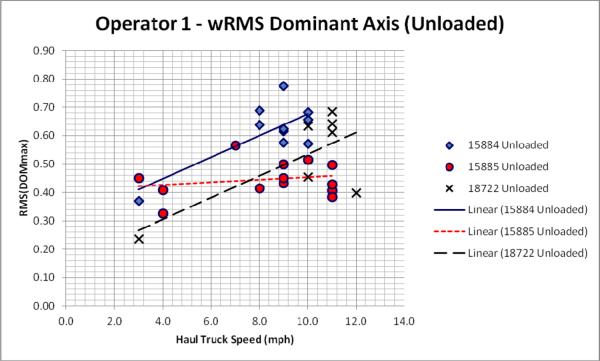
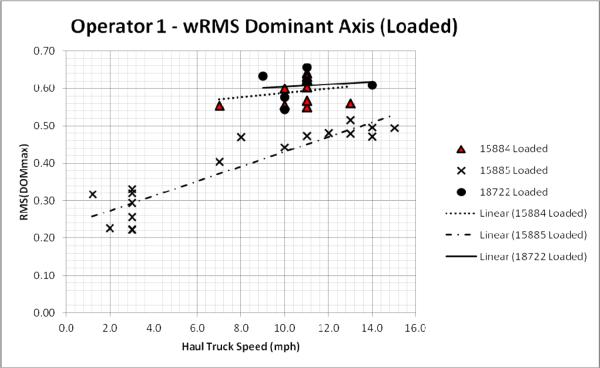
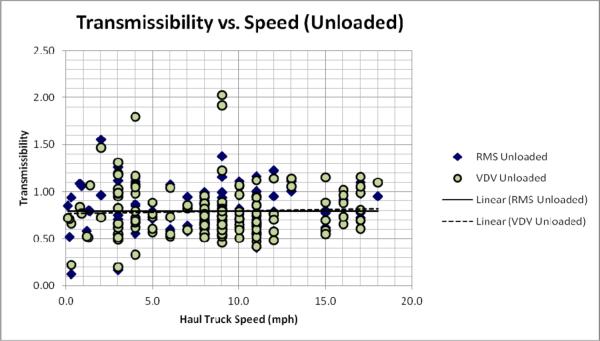
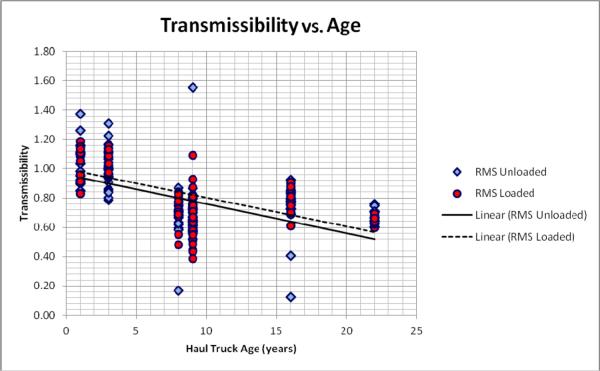
Description:To further assess vibration exposure on haul trucks (HTs) and front-end wheel loaders (FELs), follow-up investigations were conducted at two US crushed stone operations. The purpose was to: 1) evaluate factors such as load/no-load conditions, speed, load capacity, vehicle age, and seat transmissibility relative to vibration exposure; 2) compare exposure levels with existing ISO/ANSI and EUGPG guidelines. Increasing HT speed increased recorded vibration at the chassis and seat as expected. Neither vehicle load nor vehicle speed increased transmissibility. Increasing HT size and age did show transmissibility decreasing. HT dominant-axis wRMS levels (most often the y-axis, lateral or side-to-side direction) were predominantly within the health guidance caution zone (HGCZ). However, several instances showed vibration dose value (VDV) above the exposure limit value (ELV) for the ISO/ANSI guidelines. VDV levels (all dominant x-axis or fore-aft) were within and above the HGCZ for the EUGPG and above the HGCZ for ISO/ANSI guidelines.
-
Subjects:
-
Source:Int J Heavy Veh Syst. 21(3):241-261.
-
Pubmed ID:26361493
-
Pubmed Central ID:PMC4562899
-
Document Type:
-
Funding:
-
Volume:21
-
Issue:3
-
Collection(s):
-
Main Document Checksum:urn:sha256:af1a72fc9f0cbaf258f6828bdabcdf0b27c38b426a9a398ac8e96fec00e37c39
-
Download URL:
-
File Type:
 [PDF
- 1.24 MB
]
[PDF
- 1.24 MB
]
Supporting Files


ON THIS PAGE





CDC STACKS serves as an archival repository of CDC-published products including
scientific findings,
journal articles, guidelines, recommendations, or other public health information authored or
co-authored by CDC or funded partners.
As a repository, CDC STACKS retains documents in their original published format to ensure public access to scientific information.
As a repository, CDC STACKS retains documents in their original published format to ensure public access to scientific information.
You May Also Like
COLLECTION
CDC Public Access