


The Health-System Benefits and Cost-effectiveness of Using Mycobacterium Tuberculosis Direct Nucleic Acid Amplification Testing to Diagnose Tuberculosis Disease in the United States
Supporting Files

-
Aug 2013
-
File Language:
English
Details
-
Alternative Title:Clin Infect Dis
-
Personal Author:
-
Description:Background
The utility of Mycobacterium tuberculosis direct nucleic acid amplification testing (MTD) for pulmonary tuberculosis disease diagnosis in the United States has not been well described.
Methods
We analyzed a retrospective cohort of reported patients with suspected active pulmonary tuberculosis in 2008–2010 from Georgia, Hawaii, Maryland, and Massachusetts to assess MTD use, effectiveness, health-system benefits, and cost-effectiveness.
Results
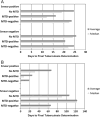
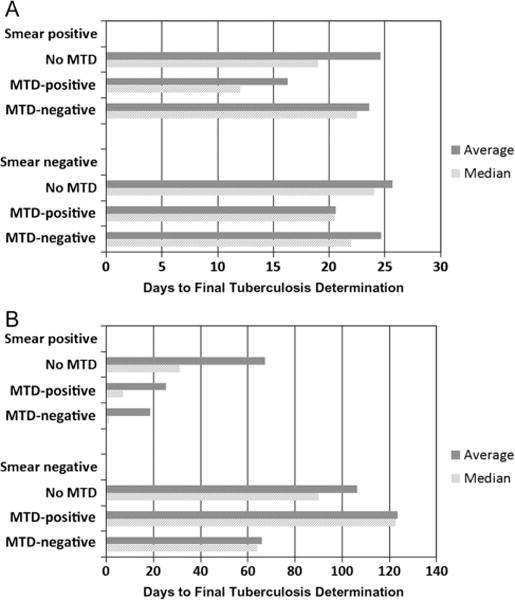
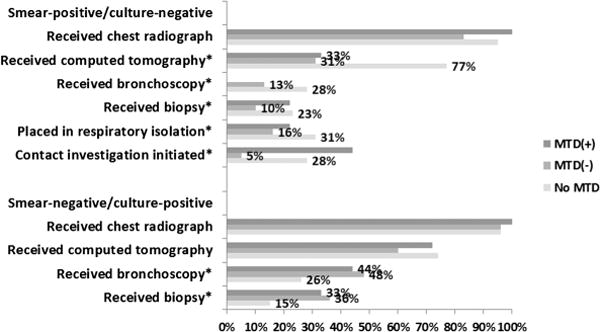
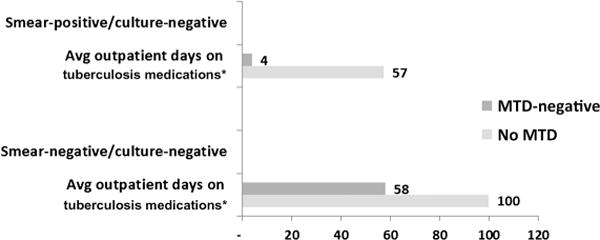
Among 2140 patients in whom pulmonary tuberculosis was suspected, 799 (37%) were M. tuberculosis-culture-positive. Eighty percent (680/848) of patients having acid-fast-bacilli-smear-positive specimens had MTD performed; MTD positive-predictive value (PPV) was 98% and negative-predictive value (NPV) was 94%. Nineteen percent (240/1292) of patients having smear-negative specimens had MTD; MTD PPV was 90% and NPV was 88%. Among patients suspected of tuberculosis but not having MTD, smear PPV for lab-confirmed tuberculosis was 77% and NPV 78%. Compared with no MTD, MTD significantly decreased time to diagnosis in patients with smear-positive/MTD-positive specimens, decreased respiratory isolation for patients having smear-positive/MTD-negative/culture-negative specimens, decreased outpatient days of unnecessary tuberculosis medications, and reduced resources expended on contact investigation. While MTD generally cost more than no MTD, incremental cost savings occurred in patients with human immunodeficiency virus (HIV) or homelessness to diagnose or to exclude tuberculosis, and in patients with substance abuse having smear-negative specimens to exclude tuberculosis.
Conclusions
MTD improved diagnostic accuracy and timeliness and reduced unnecessary respiratory isolation, treatment, and contact investigations. It was cost saving in patients with HIV, homelessness, or substance abuse, but not in others.
-
Subjects:
-
Source:Clin Infect Dis. 57(4):532-542.
-
Pubmed ID:23697743
-
Pubmed Central ID:PMC4566959
-
Document Type:
-
Funding:
-
Place as Subject:
-
Volume:57
-
Issue:4
-
Collection(s):
-
Main Document Checksum:urn:sha256:c9540a38be9e0ad7a171288cdf07366d80fda9e99f2c74e5da55eab015f204b9
-
Download URL:
-
File Type:
 [PDF
- 471.75 KB
]
[PDF
- 471.75 KB
]
Supporting Files


File Language:
English
ON THIS PAGE




CDC STACKS serves as an archival repository of CDC-published products including
scientific findings,
journal articles, guidelines, recommendations, or other public health information authored or
co-authored by CDC or funded partners.
As a repository, CDC STACKS retains documents in their original published format to ensure public access to scientific information.
As a repository, CDC STACKS retains documents in their original published format to ensure public access to scientific information.
You May Also Like
COLLECTION
CDC Public Access