


Discontinuation of thyroid hormone treatment among children in the United States with congenital hypothyroidism: findings from health insurance claims data
Supporting Files
Public Domain

-
Feb 15 2010
File Language:
English
Details
-
Alternative Title:BMC Pediatr
-
Personal Author:
-
Description:Background
Thyroid hormone treatment in children with congenital hypothyroidism can prevent intellectual disability. Guidelines recommend that children diagnosed with congenital hypothyroidism through newborn screening remain on treatment to at least 3 years of age, after which a trial off therapy can determine which children have transient hypothyroidism. The purpose of this study was to describe the rate at which children with congenital hypothyroidism in the United States discontinue thyroid hormone treatment in early childhood.
Methods
Retrospective analysis of the 2002-2006 MarketScan® Commercial Claims and Encounters research databases and the 2001-2005 MarketScan Multi-State Medicaid databases. Children were classified as having congenital hypothyroidism based on billing codes and having filled a prescription for thyroid hormone treatment. Kaplan-Meier curve analysis was used to determine discontinuation rates.
Results
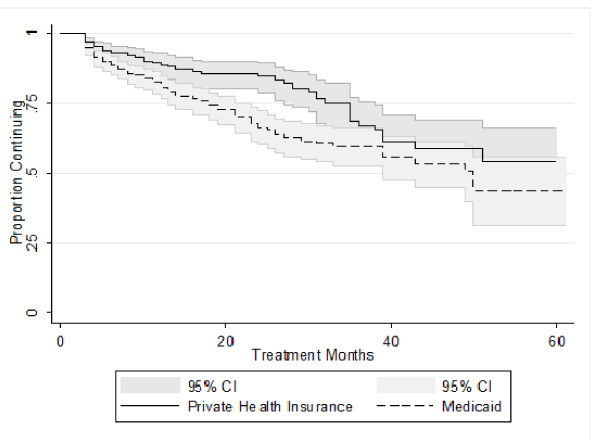
There were a total of 412 Medicaid-enrolled children and 292 privately-insured children with presumed congenital hypothyroidism included in this study. The overall birth prevalence of congenital hypothyroidism across both datasets was about 1 per 2,300. By 36 months, the percentage who had discontinued thyroid replacement treatment was 38% (95% Confidence Interval: 32%-44%). Medicaid-enrolled children had a more rapid decline in the first 24 months of treatment compared to those with private insurance (P = 0.02).
Conclusions
More than one-third of children treated for congenital hypothyroidism discontinued treatment within 36 months, which is inconsistent with current guidelines. It is not known how many of these children required continued treatment or experience adverse effects from discontinuation. These findings emphasize the critical need for follow-up systems to monitor the outcome of newborn screening.
-
Subjects:
-
Source:BMC Pediatr. 2010; 10:9.
-
Document Type:
-
Place as Subject:
-
Volume:10
-
Collection(s):
-
Main Document Checksum:urn:sha-512:95d9c7195cecd717d09e21c2831a295fe2aa447a9e9dfa86f43d06ccaa5b23caa4a8abec8d1c2ca15ba0d0684ebf07cc12482693238b14407536cf9227b20947
-
Download URL:
-
File Type:
 [PDF
- 318.06 KB
]
[PDF
- 318.06 KB
]
Supporting Files


File Language:
English
ON THIS PAGE

CDC STACKS serves as an archival repository of CDC-published products including
scientific findings,
journal articles, guidelines, recommendations, or other public health information authored or
co-authored by CDC or funded partners.
As a repository, CDC STACKS retains documents in their original published format to ensure public access to scientific information.
As a repository, CDC STACKS retains documents in their original published format to ensure public access to scientific information.
You May Also Like
COLLECTION
CDC Public Access