



STIMULUS AND TRANSDUCER EFFECTS ON THRESHOLD
Supporting Files

-
2 2015 ; 2-2015
-
Available in CDC Stacks on February 01, 2016, 12:00 AM
File Language:
English
Details
-
Alternative Title:Int J Audiol
-
Personal Author:
-
Description:Objective
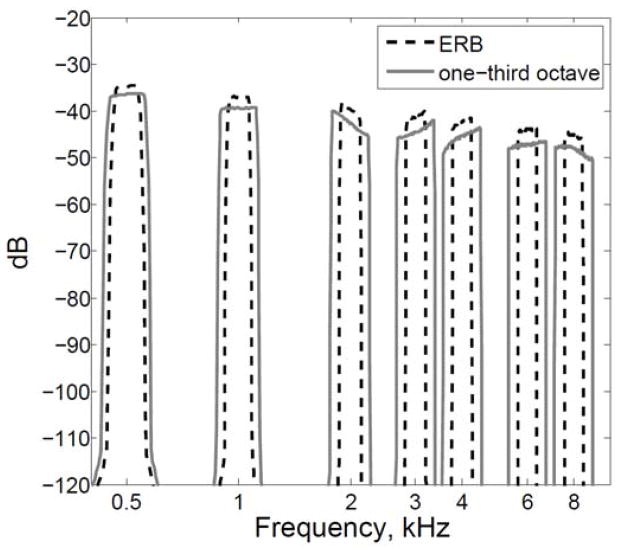
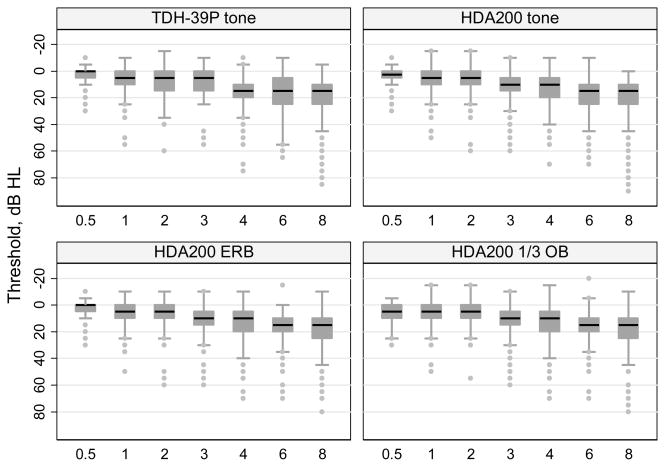
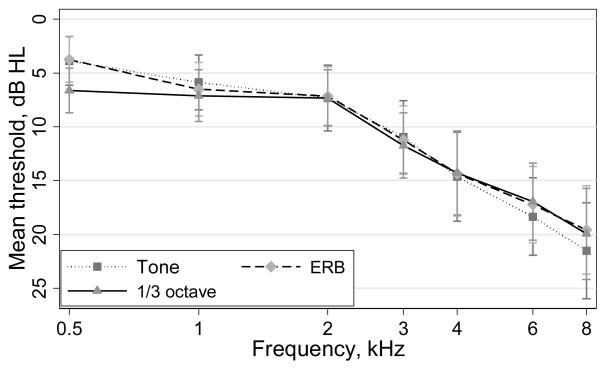
This study examined differences in thresholds obtained under Sennheiser HDA200 circumaural earphones using pure tone, equivalent rectangular noise bands, and 1/3 octave noise bands relative to thresholds obtained using Telephonics TDH-39P supra-aural earphones.
Design
Thresholds were obtained via each transducer and stimulus condition six times within a 10-day period.
Study Sample
Forty-nine adults were selected from a prior study to represent low, moderate, and high threshold reliability.
Results
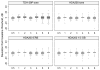
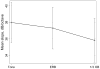
The results suggested that (1) only small adjustments were needed to reach equivalent TDH-39P thresholds, (2) pure-tone thresholds obtained with HDA200 circumaural earphones had reliability equal to or better than those obtained using TDH-39P earphones, (3) the reliability of noise-band thresholds improved with broader stimulus bandwidth and was either equal to or better than pure-tone thresholds, and (4) frequency-specificity declined with stimulus bandwidths greater than one Equivalent Rectangular Band, which could complicate early detection of hearing changes that occur within a narrow frequency range.
Conclusions
These data suggest that circumaural earphones such as the HDA200 headphones provide better reliability for audiometric testing as compared to the TDH-39P earphones. These data support the use of noise bands, preferably ERB noises, as stimuli for audiometric monitoring. -
Subjects:
-
Keywords:
-
Source:Int J Audiol. 54(0 1):S19-S29
-
Pubmed ID:25549164
-
Pubmed Central ID:PMC4559258
-
Document Type:
-
Funding:
-
Volume:54
-
Download URL:
-
File Type:
 [PDF - 1.09 MB]
 -
Collection(s):
-
Main Document Checksum:urn:sha256:7a53b57990083c0fb85d5f2b6c81316dd7ea90d06c8ff7917bf0be6a13247de6
Supporting Files


File Language:
English
 Was this page helpful?
 Found an issue?




CDC STACKS serves as an archival repository of CDC-published products including
scientific findings, journal articles, guidelines, recommendations, or other public health information authored or
co-authored by CDC or funded partners.
As a repository, CDC STACKS retains documents in their original published format to ensure public access to scientific information.
As a repository, CDC STACKS retains documents in their original published format to ensure public access to scientific information.
You May Also Like
COLLECTION
CDC Public Access