


Integrated cluster- and case-based surveillance for detecting stage III zoonotic pathogens: an example of Nipah virus surveillance in Bangladesh
Supporting Files

-
Oct 24 2014
-
File Language:
English
Details
-
Alternative Title:Epidemiol Infect
-
Personal Author:
-
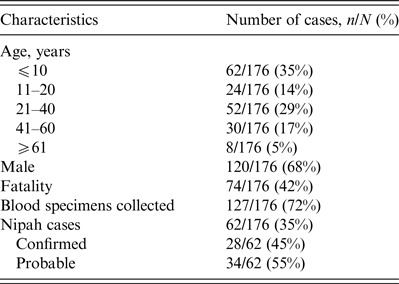
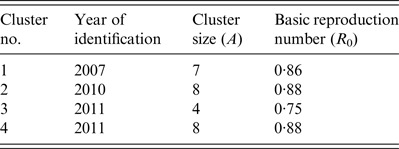
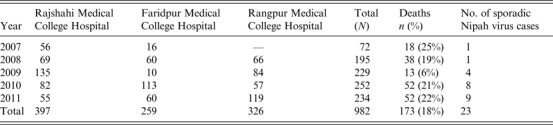
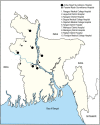
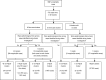
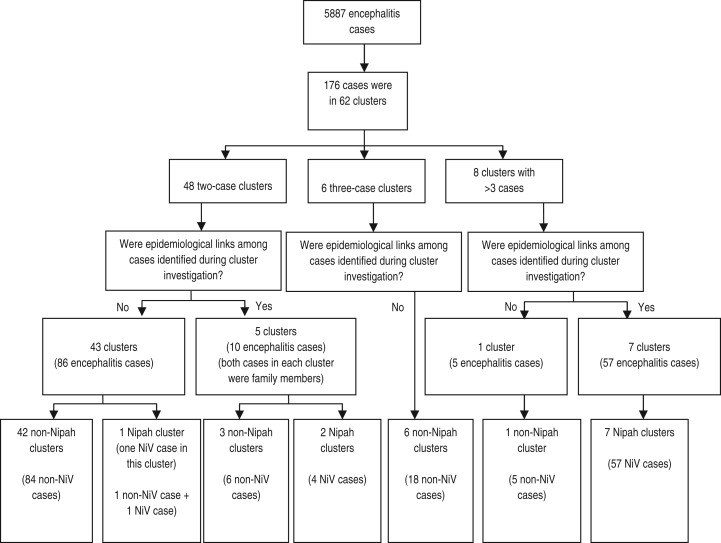
Description:This paper explores the utility of cluster- and case-based surveillance established in government hospitals in Bangladesh to detect Nipah virus, a stage III zoonotic pathogen. Physicians listed meningo-encephalitis cases in the 10 surveillance hospitals and identified a cluster when ⩾2 cases who lived within 30 min walking distance of one another developed symptoms within 3 weeks of each other. Physicians collected blood samples from the clustered cases. As part of case-based surveillance, blood was collected from all listed meningo-encephalitis cases in three hospitals during the Nipah season (January-March). An investigation team visited clustered cases' communities to collect epidemiological information and blood from the living cases. We tested serum using Nipah-specific IgM ELISA. Up to September 2011, in 5887 listed cases, we identified 62 clusters comprising 176 encephalitis cases. We collected blood from 127 of these cases. In 10 clusters, we identified a total of 62 Nipah cases: 18 laboratory-confirmed and 34 probable. We identified person-to-person transmission of Nipah virus in four clusters. From case-based surveillance, we identified 23 (4%) Nipah cases. Faced with thousands of encephalitis cases, integrated cluster surveillance allows targeted deployment of investigative resources to detect outbreaks by stage III zoonotic pathogens in resource-limited settings.
-
Subjects:
-
Source:Epidemiol Infect. 2014; 143(9):1922-1930.
-
Pubmed ID:25342551
-
Pubmed Central ID:PMC4456770
-
Document Type:
-
Funding:
-
Place as Subject:
-
Volume:143
-
Issue:9
-
Collection(s):
-
Main Document Checksum:urn:sha256:5d00236613957dd2f8fb800d14a2f7b79b36382309597c2a2d3518b0401956be
-
Download URL:
-
File Type:
 [PDF
- 292.94 KB
]
[PDF
- 292.94 KB
]
Supporting Files


File Language:
English
ON THIS PAGE



CDC STACKS serves as an archival repository of CDC-published products including
scientific findings,
journal articles, guidelines, recommendations, or other public health information authored or
co-authored by CDC or funded partners.
As a repository, CDC STACKS retains documents in their original published format to ensure public access to scientific information.
As a repository, CDC STACKS retains documents in their original published format to ensure public access to scientific information.
You May Also Like
COLLECTION
CDC Public Access